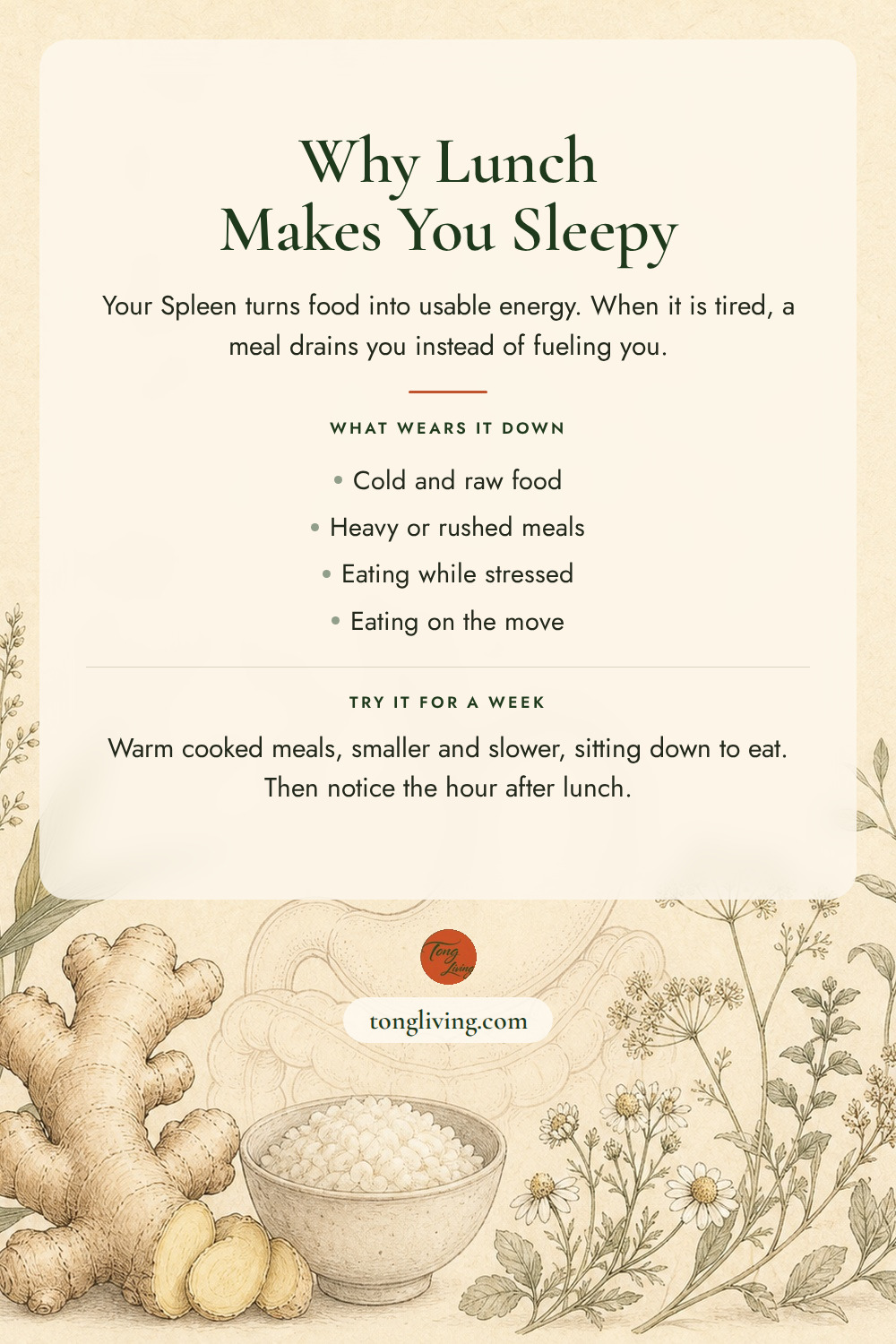

Feeling sleepy after eating does not automatically mean that something is wrong with your blood sugar, your digestion or your willpower. A meal, especially a large one, can be followed by a period of reduced alertness. The time of day, the previous night’s sleep, alcohol, the size of the meal and what you do afterwards can all change how noticeable that dip feels.
But “I feel tired after eating” can also describe something more disruptive: a fog that arrives after nearly every meal, a need to lie down, a shaky crash a few hours later, or tiredness that comes with bloating, pain, diarrhea, thirst or another symptom.
Those experiences should not be folded into one explanation. Start by asking two questions: How soon does the tiredness begin, and what arrives with it?
When is a post-meal dip ordinary?
Post-meal sleepiness is sometimes called postprandial somnolence. Researchers have not reduced it to one simple mechanism. Studies have found that alertness can decrease after eating, but the effect varies with meal size and composition, time of day, sleep pressure and the person being studied.
That matters because the meal may not be acting alone. If lunch falls inside your usual early-afternoon dip, the food and your body clock can reinforce each other. If you slept badly, a normal quietening after a meal may feel like exhaustion. A large lunch followed by a warm room and an hour of sitting will feel different from the same food eaten after good sleep and followed by a short walk.
An ordinary dip is usually mild, temporary and proportionate to the circumstances. You may feel less sharp for a while, but you can still function. It does not arrive with faintness, confusion, marked shakiness or another concerning symptom.
When does tiredness after eating deserve a closer look?
Arrange a healthcare assessment if the fatigue is severe, new, worsening, happens after most meals, interferes with driving or work, or comes with persistent digestive symptoms, unexplained weight change, unusual thirst, frequent urination, blurred vision, pallor, breathlessness or an overall decline in energy.
Seek urgent help for severe confusion, fainting, a seizure, difficulty speaking or other sudden neurological symptoms. People who take insulin or medicines that can cause low blood glucose should follow their personal treatment plan for suspected hypoglycaemia and seek urgent help if symptoms are severe or do not improve.
Low blood glucose can cause tiredness, but tiredness by itself does not prove that your glucose is low. In people with diabetes, hypoglycaemia can also cause shakiness, hunger, dizziness, sweating, a fast or irregular heartbeat, headache, irritability or confusion, and it can become dangerous. Diabetes itself can include fatigue together with increased thirst or hunger, frequent urination, blurred vision and unintentional weight loss. Testing, not guesswork, is what separates these possibilities.
Digestive symptoms add another reason to look more widely. Celiac disease, for example, can include both fatigue and symptoms such as bloating, diarrhea, constipation, gas, nausea or abdominal pain. Many other conditions can produce similar symptoms, so do not remove gluten or build a restrictive diet around one article. If celiac disease is a possibility, ask about testing before removing gluten, because avoiding it can affect the diagnostic process.
Which pattern of tiredness after eating fits what you notice?
The phrase becomes more useful when you make it specific.
1. You become sleepy after a large meal
The tiredness begins fairly soon after eating. The meal was larger or richer than usual, perhaps eaten quickly, and you feel heavy and quiet rather than shaky or unwell. The effect is stronger when you are underslept or sitting still.
This is a reasonable place to test meal size and pace. It is not proof that one ingredient is bad for you. A smaller meal eaten more slowly may produce a different result even when the foods are similar.
2. The crash belongs mainly to lunch or dinner
If lunch is the problem but breakfast is not, look at the clock as well as the plate. Many people experience an early-afternoon reduction in alertness. A short night, a demanding morning and a large lunch can gather in the same hour and make the food look solely responsible.
If dinner is the main problem, ask what preceded it. Did you go too long without eating? Is it your largest meal? Is alcohol involved? Are you finally stopping after a day that kept you artificially alert?
The Chinese medicine body clock guide can help you examine repeatable timing, but the clock is not a diagnostic test. A symptom that happens at 2pm still needs ordinary questions about sleep, food, medication, work and health.
3. Tiredness arrives with bloating, fullness or bowel changes
When fatigue travels with pressure, belching, bloating, nausea, pain, diarrhea or constipation, the digestive symptoms are part of the story. Notice whether the problem follows every substantial meal, one ingredient, very fast eating, or periods when your digestion is already unsettled.
The article on feeling bloated after eating healthy food explains why a food’s reputation does not determine how easy it is for a particular person to digest in a particular form and amount. Repeated or significant symptoms still deserve medical assessment rather than an ever-narrower list of permitted foods.
4. You feel shaky, sweaty or intensely hungry later
A crash one to four hours after eating is different from becoming pleasantly sleepy at the table. If it includes shaking, sweating, palpitations, dizziness, confusion, blurred vision or urgent hunger, do not label it a “sugar crash” without assessment.
Hypoglycaemia is especially important for people who use insulin or certain diabetes medicines, but similar sensations can have other causes. Record the timing and symptoms and discuss them with a healthcare professional. Do not try to diagnose them by repeatedly provoking the episode or by making large, unsupervised changes to medication or food.
5. You were already tired before the meal
Sometimes eating reveals fatigue rather than creates it. Hunger, caffeine, deadlines or stress can hold you upright for part of the day. Once you sit down and the demand pauses, the exhaustion becomes visible.
Ask whether you wake refreshed, whether you are tired between meals and whether movement helps or depletes you. Different kinds of tiredness after sleeping may help you describe the wider pattern. If the fatigue is persistent, a clinician may need to consider sleep, medicines, anemia, thyroid function, infection, mood, nutrition or other causes.
What does Chinese medicine add to the question?
Chinese medicine does not treat “tired after eating” as one diagnosis. It asks how the body receives food, transforms it and distributes what is useful, then compares that process with appetite, stool, bloating, temperature, thirst, sleep and the quality of the fatigue.
In the traditional framework, post-meal heaviness with bloating, loose stools, poor appetite and a pale, depleted feeling may be described through a pattern such as Spleen Qi deficiency. Tiredness with pronounced coldness and a strong preference for warmth may be read differently. Fullness, irritability, belching and symptoms that worsen with tension may suggest that movement and digestion are interacting rather than that the body simply lacks energy.
These are traditional pattern descriptions. Spleen Qi deficiency is not a biomedical spleen disorder, and it is not another name for diabetes, celiac disease, food intolerance or low blood glucose. A traditional interpretation should never be used to delay testing for a medical condition.
| Compare | One side | The other side |
|---|---|---|
| Quality | Pleasantly sleepy | Shaky, sweaty, dizzy, confused, or urgently hungry |
| Timing | Immediate heaviness at the table | A crash one to four hours later |
| Frequency | Every meal or ordinary portions | One time of day or only larger meals |
| Companion signs | Bloating, fullness, or bowel changes | Tiredness without digestive symptoms |
| Movement | Gentle movement improves the feeling | Any exertion makes it worse |
| Starting point | The meal precedes the fatigue | The fatigue was present before eating |
This is what it means to read a body pattern rather than one isolated symptom. The pattern does not replace a diagnosis. It helps you ask a better question.
What should you track across seven meals?
If the tiredness is mild and no warning sign is present, observe seven ordinary meals before changing your entire diet. You are looking for a repeatable relationship, not trying to prove a theory.
Start before the meal
Record the time, how hungry you are and how much energy you have before eating. Add the previous night’s sleep and whether you have been active, sitting or under pressure. Otherwise a difficult morning can be misremembered as a difficult lunch.
Describe the meal without moral labels
Note the approximate size, the main foods, whether it was warm or cold, and how quickly you ate. “Healthy” and “unhealthy” are too vague for this purpose. A large raw salad, a bowl of soup and a sandwich can all be healthy choices while creating different digestive loads for different people.
Mark the beginning of the change
Did you feel sleepy while eating, twenty minutes later or three hours later? Record heaviness, fog, hunger, bloating, pain, thirst, shakiness, sweating or palpitations. Also note how long the change lasted.
Record what happened next
Did you sit, work, drive, nap or walk? A systematic review found that activity after eating, including walking, can reduce post-meal glucose excursions, although the studies were small and often at high risk of bias. That does not mean every tired person has a glucose problem. It makes a gentle walk, if it is safe for you, a reasonable experiment in movement rather than a treatment claim.
Change one variable
After you have a few observations, test one modest change. Try a slightly smaller meal, a slower pace, a more balanced mix of fiber, protein and fat, or ten minutes of gentle movement afterwards. Keep the rest of the meal recognisable. If you change five things at once, improvement teaches you very little.
Do not respond to post-meal fatigue by skipping meals, fearing carbohydrates or removing whole food groups without a clear reason. The goal is to learn what changes the experience, not to make eating more anxious.
Why is the useful answer more specific than “food makes me tired”?
A mild, temporary dip after a large meal can be ordinary. A severe or repeatable crash, especially one accompanied by digestive symptoms, shakiness, thirst, frequent urination, weight change or persistent fatigue, deserves a wider look.
Separate the meal from the hour around it. Ask what your energy was before eating, how soon the change began, what else you felt and what restored you. That information is more useful than deciding in advance that the problem must be blood sugar, gluten, raw food or weak digestion.
Chinese medicine contributes a way of noticing relationships. Modern medicine provides tests and diagnoses that observation cannot safely supply. Used together, they can turn a vague complaint into a clear description and a more proportionate next step.
For the fuller Tong Living method for reading digestion together with energy, sleep, temperature, emotion, movement and climate, see Tong Living Everyday Chinese Medicine: for the Way Your Body Works.
Sources and further reading
- Low Blood Glucose (Hypoglycemia), National Institute of Diabetes and Digestive and Kidney Diseases
- Symptoms of Diabetes, Centers for Disease Control and Prevention
- Symptoms and Causes of Celiac Disease, National Institute of Diabetes and Digestive and Kidney Diseases
- Diagnosis of Celiac Disease, National Institute of Diabetes and Digestive and Kidney Diseases
- Meal Composition and Its Effect on Postprandial Sleepiness, Physiology & Behavior
- Performance and Sleepiness During a 24-Hour Wake in Constant Conditions Are Affected by Diet, Biological Psychology
- After Dinner Rest a While, After Supper Walk a Mile? A Systematic Review with Meta-analysis, Sports Medicine
- Traditional Chinese Medicine: What You Need to Know, National Center for Complementary and Integrative Health