The clock
All twelve windows on one page. Which system is working when, and which six hours your body would rather you were asleep for.

Chinese medicine maps the day into twelve two-hour windows. Each one belongs to a system in your body, and each has a job it does best. Wake at the same time most nights and the hour itself is a clue.
Get the free chart. Three pages, no cost, no course, nothing to join.
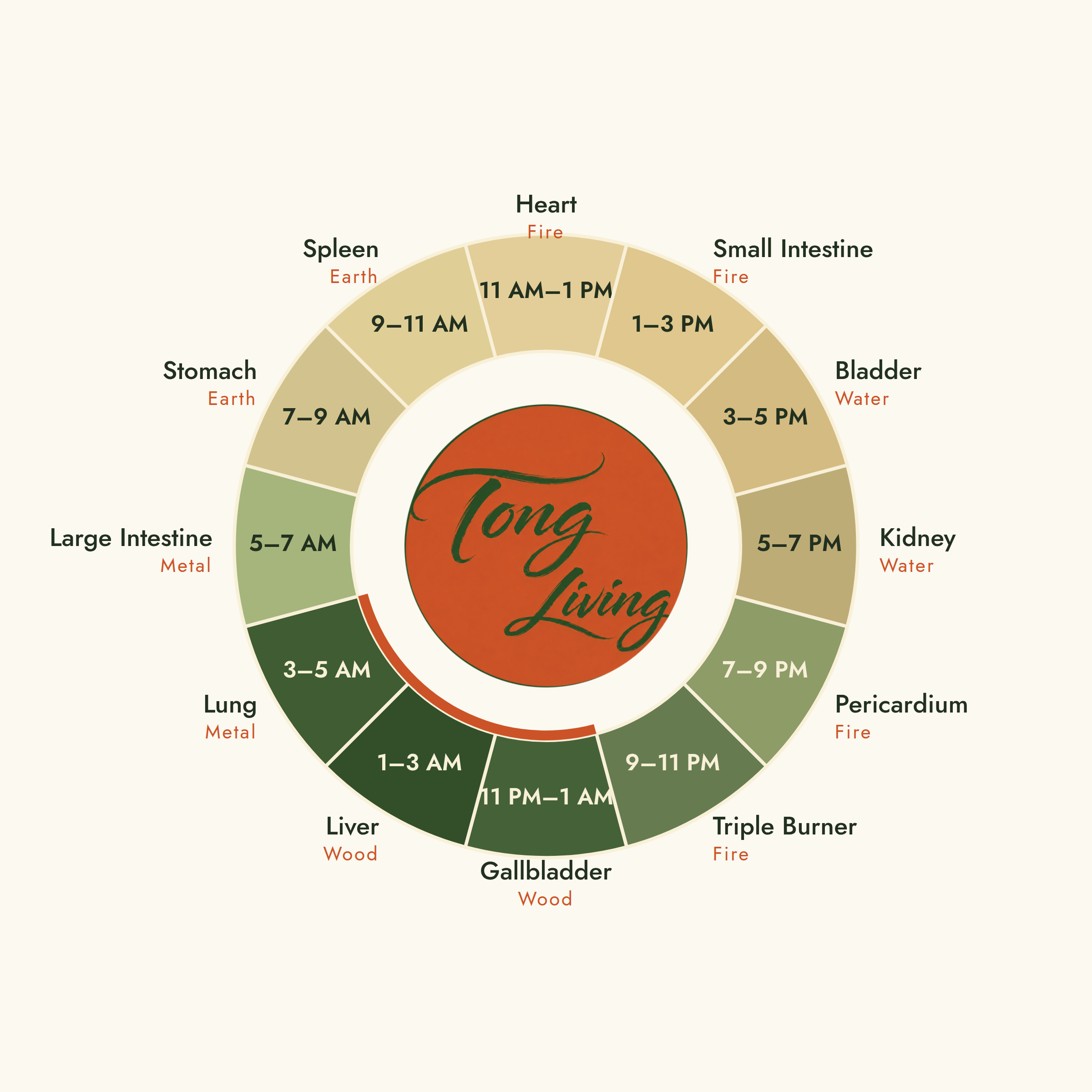
All twelve windows on one page. Which system is working when, and which six hours your body would rather you were asleep for.
One small thing per window. Warm water on waking, your hardest thinking before lunch, the reason a 3pm crash is not a coffee problem.
The difference between waking at 1am and waking at 4am, what each one usually means, and what actually helps. The answer is rarely at 4am.
This is not a schedule to keep. Most of us cannot eat at seven and sleep at eleven, and a chart that demands it is no use on a real Tuesday. Find the one window where your day reliably goes wrong, work with that one for a week, and see what shifts.

I am Wenjing. I was born in China, where Chinese medicine was simply part of ordinary life, something my grandmother knew and something in the kitchen. I left at twenty-five, earned a PhD in Australia, and spent twelve years as an aviation lecturer in the Netherlands learning to read complex systems. Then the diet that had kept me well in one country started making me ill in another, my tests came back normal, and I had to go and understand why. That took me to a diploma in acupuncture, and then to writing the book I had wanted to read.
Educational only. This chart is for tending, not for diagnosis. Broken sleep has ordinary causes too, so if your sleep changed suddenly, or comes with pain, breathlessness, night sweats, or a low mood that will not lift, please see a clinician first.