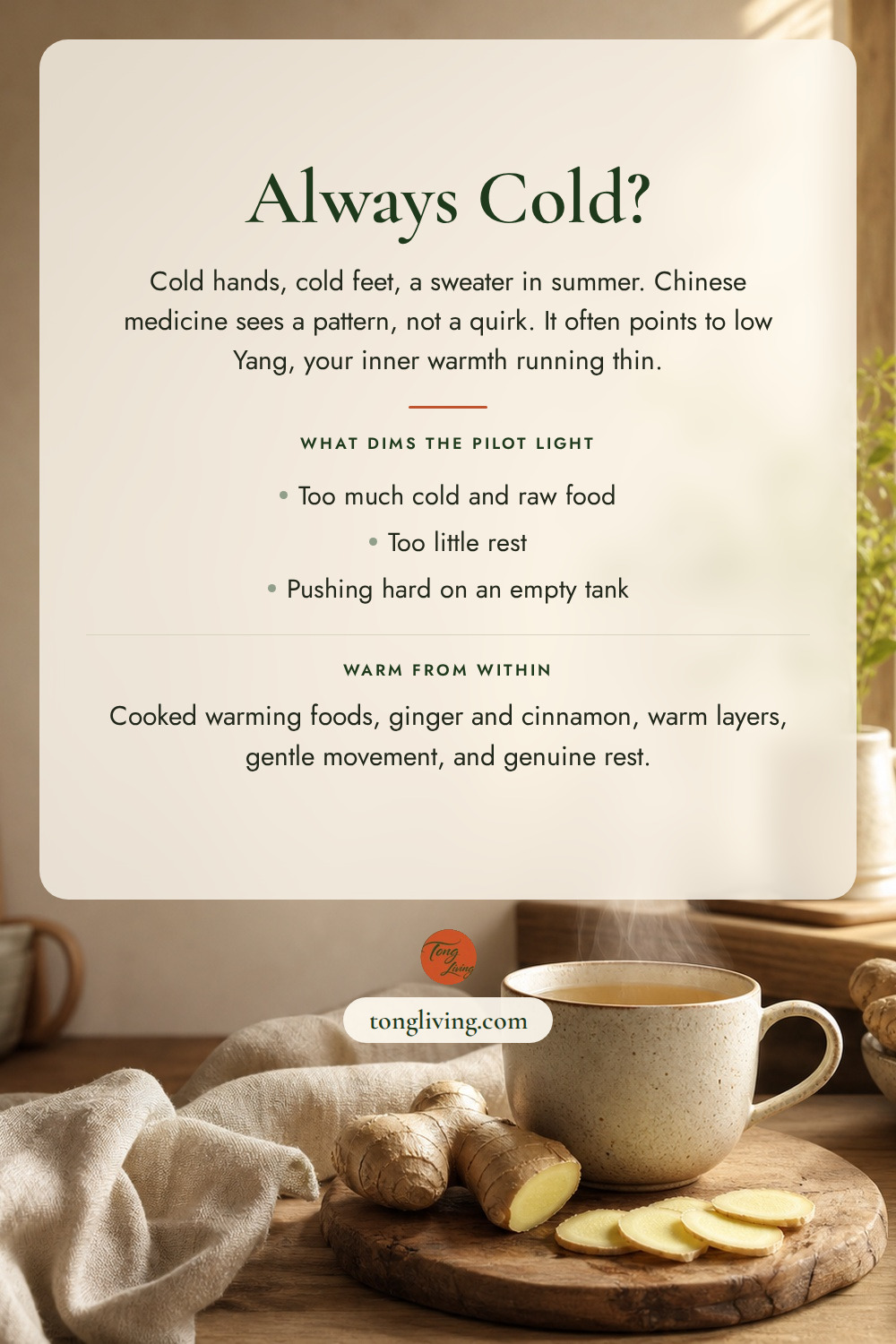
Cold hands and feet do not automatically mean that your circulation is poor. They tell you that less warmth is reaching your extremities at that moment. The useful question is why.
Sometimes the answer is simple: the room is cold, you have been sitting still, or your body is conserving heat around its core. Sometimes the change is episodic and intense, with fingers turning white or blue before flushing red as they warm. Sometimes your whole body feels colder than other people, and the cold arrives with fatigue, pallor, constipation, dry skin, dizziness or another symptom.
Those are not the same pattern. Before you buy another pair of thermal socks or decide that you have a Chinese medicine deficiency, notice the company the cold keeps.
Why can your hands and feet feel cold?
When the body is exposed to cold, blood vessels near the skin narrow. This reduces heat loss and keeps more warm blood around the core, where the vital organs are. Your fingers and toes are far from that core and have a large surface area relative to their size, so they often cool first.
That response can be normal. The same person may have warm hands while walking and cold hands after an hour at a desk. A cool supermarket, wet shoes or holding an iced drink can be enough to change the sensation.
The phrase “poor circulation” is too broad to explain what is happening. It can make an ordinary, reversible response sound like permanent damage, or make a medical symptom sound too ordinary. The details separate those possibilities.
When do cold hands or feet need medical attention?
Arrange a healthcare assessment if the cold is new, persistent, getting worse, markedly different on one side, or accompanied by ongoing numbness, pain, weakness, skin changes, slow-healing sores or color changes. Long-term or extreme cold intolerance also deserves assessment.
Seek urgent help if a hand or foot suddenly becomes very pale, blue or gray and painful, especially if it does not improve with gentle warming, or if blue or gray skin appears with breathlessness, chest pain, confusion or dizziness.
Cold extremities can occur with Raynaud’s phenomenon. They can also appear alongside iron-deficiency anemia, an underactive thyroid, some medicines, nicotine use and other conditions. The symptom alone cannot tell you which explanation applies. Do not start iron, thyroid products or circulation supplements on the basis of cold hands or feet alone.
Which patterns can cold hands and feet follow?
The same complaint can describe four quite different experiences.
1. They cool in a cold or still environment, then warm normally
Your hands become cool in air conditioning, while sitting at a desk or after being outdoors, but their color stays normal. Movement, a warmer room or another layer restores comfort without pain or a dramatic rebound.
This may simply be the body regulating heat. Look at the conditions before looking for a disorder. Were you still for a long time? Was your torso lightly dressed? Were your hands damp? Did the symptom disappear once your whole body warmed?
The article on why weather changes how you feel explains why temperature, wind, dampness, clothing, activity and acclimatization can produce different loads in different people.
2. Cold or stress triggers a clear attack
Raynaud’s phenomenon causes blood vessels in the fingers or toes to narrow quickly and remain narrowed for too long. During an attack, an area may become cold and numb and change from white to blue, then turn red, tingle, burn or throb as blood flow returns. Cold is a common trigger, but emotional stress can also provoke an attack.
Primary Raynaud’s has no known underlying cause and is often mild. Secondary Raynaud’s is associated with another condition or exposure and can be more serious. A clinician uses the history, examination and sometimes tests to distinguish them.
If stress reliably precedes the color change, that does not mean the symptom is imaginary. Stress signaling can narrow blood vessels. The article on why stress returns after you relax may help you identify the earlier bodily signs of activation, while proper medical assessment still matters for suspected Raynaud’s.
3. Your whole body feels cold, not only your extremities
Cold intolerance is different from hands that cool temporarily. You may need more layers than everyone else, struggle to warm up, or feel cold in conditions that other people find comfortable.
The surrounding symptoms matter. Iron-deficiency anemia can include fatigue, dizziness, pale skin and cold hands or feet. An underactive thyroid can cause trouble tolerating cold together with symptoms such as fatigue, dry skin, constipation, weight change, muscle or joint discomfort, or changes to menstrual periods. Each symptom is common and none proves a diagnosis by itself.
If coldness travels with persistent fatigue, different kinds of tiredness after sleeping can help you describe the experience more precisely. It cannot replace blood tests or a clinical assessment when those are indicated.
4. Your hands are cold while the rest of you feels tense or overheated
Some people feel warm in the face or chest while their hands stay cold. Others notice cold fingers during a difficult conversation, before speaking in public or while rushing through a demanding day.
This does not fit the simple picture of a body that lacks warmth everywhere. Arousal, posture, shallow breathing, muscle tension and long periods without movement can all change what you feel at the edges of the body. Notice whether your hands warm when the situation ends, when you move or when your breathing settles.
The contrast matters. “I am cold” and “my hands are cold” are different observations.
What does Chinese medicine add to the question?
Chinese medicine treats temperature as one part of a larger pattern. It does not ask only whether you are cold. It asks where, when, under what conditions, what improves it and what else happens at the same time.
In the traditional framework, a person who feels cold throughout the body, lacks energy and consistently improves with warmth may be read differently from someone whose cold is mainly in the hands and feet and worsens with tension. Pallor, dizziness, digestive weakness, loose stools, menstrual history, sleep and the quality of the pulse would add further context in a clinical setting.
Terms such as Yang deficiency, Qi deficiency, Blood deficiency and stagnation describe traditional patterns of function. They are not synonyms for hypothyroidism, anemia, vascular disease or any other biomedical diagnosis. A person can fit a traditional pattern without having one of those conditions, and a medical condition should not be assumed to have one fixed Chinese medicine explanation.
The useful contribution is the discipline of comparison:
- whole-body cold versus cold extremities;
- constant cold versus distinct attacks;
- normal color versus white, blue, purple or red changes;
- better with movement versus unchanged by movement;
- worse with stress versus unrelated to stress;
- cold with fatigue and pallor versus cold with tension and flushing;
- a lifelong tendency versus a new change.
That is the same reasoning behind understanding your wider body pattern. One symptom becomes more informative when you see its relationships.
What should you track for seven days?
If the symptom is mild and no warning sign is present, observe it for seven ordinary days. The goal is not to diagnose yourself. It is to replace the word “always” with a more accurate description.
Record the conditions
Note the room or outdoor temperature, whether you were wet, how long you had been still and what your torso was wearing. Hands often stay cold when the core is not warm enough, even inside gloves.
Describe the location and color
Is the cold in every finger, only a few fingertips, both feet, one side or the whole body? Does the skin remain its usual color, or become white, blue, purple or red? A photograph taken during a color-changing episode can be useful to show a clinician.
Record sensation, not just temperature
Write down numbness, pins and needles, burning, throbbing, stiffness or pain. Notice whether rewarming is comfortable or produces a strong, painful flush.
Notice what came before it
Include a cold drink, a meal, caffeine, nicotine, a stressful interaction, focused computer work, exercise or a long period without food. Record any medicine changes rather than stopping a prescribed medicine yourself.
Observe what restores warmth
Does a short walk help? Does warming your chest and abdomen work better than heating your fingers directly? Does food make a difference? How long does an episode last?
At the end of the week, look for repetition. A symptom that appears only in cold rooms is different from one that arrives after stress, after meals, on waking or without an obvious trigger.
How can you use warmth as an experiment?
For mild coldness, start with low-risk adjustments that match what you observed.
Warm your whole body rather than applying intense heat to numb skin. Add a layer around the torso, move gently after long periods of sitting and use warm, not hot, water to rewarm cold hands. Protect your hands when handling frozen food and your feet when shoes or socks become damp.
Regular meals may matter if coldness arrives when you have gone a long time without eating. Gentle movement may matter if it follows stillness. A calmer transition may matter if stress is the trigger. Change one condition at a time so that the result teaches you something.
Avoid turning the observation into a universal food rule. Warm meals may feel supportive to someone who is cold and depleted, but cold hands do not prove that raw food, iced water or a particular ingredient is the cause. Likewise, feeling better with warmth does not identify the medical reason for the symptom.
What does the pattern tell you that cold alone cannot?
Cold hands and feet can be ordinary, uncomfortable or medically important. The sensation alone cannot tell you which.
Look for the difference between cold exposure and a distinct attack, between the extremities and the whole body, between a long-standing tendency and a new change. Add color, pain, numbness, energy, digestion, stress and response to warmth. That fuller picture helps you decide whether a small adjustment is enough or whether the symptom deserves assessment.
Chinese medicine contributes a language for noticing the pattern. Modern medicine identifies conditions that observation alone cannot safely confirm. The two forms of attention are most useful when they do not pretend to replace each other.
For the fuller Tong Living method for reading internal temperature together with energy, digestion, sleep, emotion, food, movement and climate, see Tong Living Everyday Chinese Medicine: for the Way Your Body Works.
Sources and further reading
- Raynaud’s Phenomenon: Symptoms, Types and Risk Factors, National Institute of Arthritis and Musculoskeletal and Skin Diseases
- Raynaud’s Phenomenon: Diagnosis, Treatment and Steps to Take, National Institute of Arthritis and Musculoskeletal and Skin Diseases
- Cold Intolerance, MedlinePlus Medical Encyclopedia
- Iron-Deficiency Anaemia, National Heart, Lung, and Blood Institute
- Hypothyroidism, National Institute of Diabetes and Digestive and Kidney Diseases
- Traditional Chinese Medicine: What You Need to Know, National Center for Complementary and Integrative Health