
You read a difficult message and lose your appetite. A deadline approaches and your stomach tightens. The pressure finally lifts, and only then do you notice bloating, urgency, constipation, or a sudden need to eat.
The short answer
Stress can affect digestion because the brain and digestive tract continually communicate. Stress can change gut sensitivity, muscle contractions, appetite, and the way digestive sensations are experienced. The result is not the same for everyone: one person becomes constipated, another develops urgency, and another can barely eat.
Chinese medicine describes a similar pattern in different language. It asks whether pressure is constraining movement, weakening digestive capacity, or producing a mixture of both. That framework can help you observe the pattern, but it cannot diagnose the medical cause of digestive symptoms.
How can stress change digestion so quickly?
Digestion is not separate from the rest of your nervous system. The brain and gut exchange signals through neural, hormonal, immune, and metabolic pathways. Conditions such as irritable bowel syndrome are now described as disorders of gut-brain interaction because changes in this communication can affect sensitivity and bowel movement even when no visible structural damage is found.
That does not mean symptoms are imaginary or “all in your head.” It means a real digestive process is being influenced by the state of the whole system.
During stress, attention and resources shift toward the immediate demand. Appetite may fall. The abdomen may brace. Some people notice faster transit and urgency, while others slow down and become constipated. Existing reflux, dyspepsia, or IBS symptoms can also become easier to trigger.
Why does one person get diarrhea while another gets constipation?
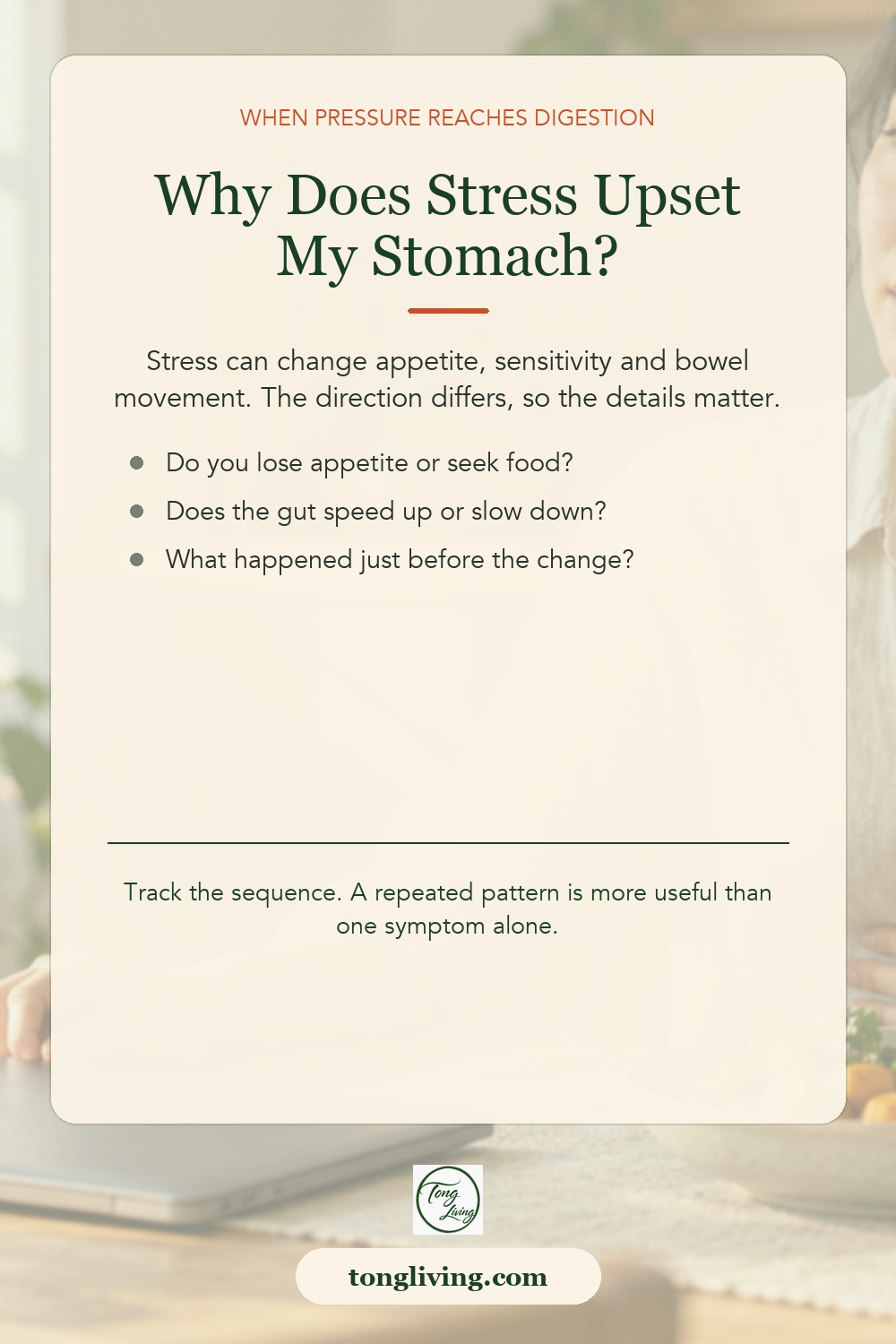
“Stress affects the gut” is only the beginning. The useful information is the direction your digestion takes.
- Urgency or loose stools: pressure may coincide with faster movement or increased sensitivity.
- Constipation or incomplete emptying: the bowel may slow, routine may change, or tension may make it harder to respond to normal urges.
- Bloating and tightness: altered movement, swallowed air, meal timing, food choices, and sensitivity can overlap.
- Loss of appetite: activation can temporarily push hunger into the background.
- Eating past fullness: food may become a fast way to change an uncomfortable state, especially after holding yourself together all day.
These patterns can have many causes besides stress. A repeated connection is useful evidence, not a diagnosis.
What does Chinese medicine notice about stress and the gut?
Chinese medicine traditionally describes smooth movement as one function of Liver Qi and transformation of food as a function of the Spleen and Stomach systems. These are functional ideas within the traditional model, not claims about the biomedical liver, spleen, or stomach.
When pressure feels held, symptoms may fluctuate with emotion: tightness, sighing, variable appetite, or bowel habits that change between constipation and looseness. When digestive capacity also feels low, the picture may include fatigue after eating, heaviness, bloating after many different foods, and loose or poorly formed stools.
The distinction matters because “move more” and “rest and nourish” are not identical responses. If you are tense but otherwise resourced, a walk or honest conversation may release what is held. If you are depleted, skipping meals and adding a hard workout can make the whole picture worse.
This is the same reason stress relief can be real without changing what keeps rebuilding the pressure.
How can you tell whether stress is part of your digestive pattern?
Look for sequence rather than coincidence. For one week, record four things when symptoms appear:
- What happened beforehand? A meeting, rushing, conflict, travel, poor sleep, or a long gap between meals?
- What changed first? Appetite, tension, breath, pain, bloating, or bowel urgency?
- What was the digestive direction? Faster, slower, tighter, heavier, emptier, or more sensitive?
- What helped? Time, food, warmth, movement, using the bathroom, finishing the task, or speaking about what was held?
You are not trying to prove that stress caused the symptom. You are looking for a repeatable order that makes the next response more precise.
What can you try without blaming yourself?
Start by reducing avoidable pressure around the meal itself.
- Sit down when possible rather than eating while moving or working.
- Give the first few bites your attention before returning to conversation or screens.
- Avoid arriving at every meal extremely hungry because stress pushed food aside all day.
- If gentle movement normally helps tightness, try a short walk after eating rather than an intense session.
- If you feel depleted and cold, choose a simple, nourishing meal instead of treating restriction as discipline.
Change one condition and check the result. The goal is not perfect calm. It is to give digestion a clearer context.
If specific healthy foods keep causing bloating, portion, fiber, preparation, and digestive capacity may matter as much as the label “healthy”. If meals make you unusually tired, read what post-meal fatigue can and cannot tell you.
When should stomach symptoms be checked medically?
Seek medical care for severe or persistent abdominal pain, blood in stool or vomit, black stools, repeated vomiting, fever, difficulty swallowing, unintentional weight loss, anemia, dehydration, symptoms that wake you repeatedly, or a lasting change in bowel habits.
Stress and a medical condition can exist together. Do not delay assessment because symptoms become worse during difficult weeks.
What is the useful question when stress reaches your gut?
Do not stop at “Am I stressed?” Ask what your digestion does under pressure and what happens first.
The direction of change can tell you whether the next small response should reduce pressure, restore regularity, move gently, nourish, or seek assessment. Your gut is not failing a stress test. It is showing how the whole system is responding.
For the fuller Tong Living framework for reading digestion together with energy, sleep, emotion, movement, timing, and climate, see Tong Living Everyday Chinese Medicine: for the Way Your Body Works.
Sources and further reading
- Definition & Facts for Irritable Bowel Syndrome, National Institute of Diabetes and Digestive and Kidney Diseases
- Symptoms & Causes of Indigestion, National Institute of Diabetes and Digestive and Kidney Diseases
- Symptoms & Causes of Constipation, National Institute of Diabetes and Digestive and Kidney Diseases
- Gut Feelings: Executive Summary, National Institute of Diabetes and Digestive and Kidney Diseases
- Traditional Chinese Medicine: What You Need To Know, National Center for Complementary and Integrative Health