One of the first things a Chinese medicine practitioner tries to understand is your pattern.
It is a word you hear often in Traditional Chinese Medicine, and it is worth pausing over, because it means something quite different from a diagnosis in the Western medical sense.
A diagnosis names a disease or condition. A pattern describes how your particular system is functioning right now.
It is not a fixed label. It is not a personality type. It is not something you carry forever.
It is more like a map.
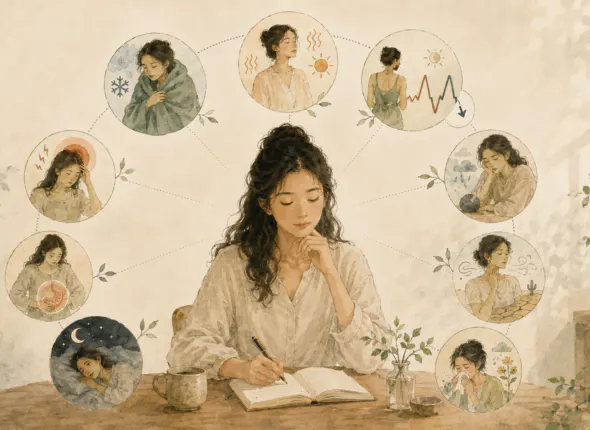
A pattern takes in the whole picture: your energy, digestion, sleep, temperature, mood, appetite, stress response, and the way your body responds to food, weather, movement, rest, and emotion. It asks not only what is happening, but how it is happening in you.
This is why two people can have the same Western diagnosis and look completely different through a Chinese medicine lens.
Two people might both be told they have chronic fatigue. But one may feel depleted in a low-fuel, hard-to-get-going way. Another may feel hollow, dry, restless, and anxious. A third may feel heavy and sluggish, as if everything is moving through mud.
In Chinese medicine, these are not treated as the same situation. They point to different patterns underneath the same complaint. And because the patterns are different, the adjustments that help are different too.
That is what makes pattern thinking practically useful.
Once you begin to see the pattern, things that seemed random often start to make sense. Why you are tired in a particular way. Why some foods settle you and others make you feel worse. Why certain seasons affect you more strongly. Why stress always seems to land in the same place: your gut, your chest, your head, your sleep, your appetite.
The pattern connects these details into one coherent picture.
You do not need to diagnose your own pattern with precision. That is what a trained practitioner is for. Pattern language does not identify the medical cause of a symptom or replace assessment. New, persistent, or worsening symptoms should be discussed with a qualified healthcare professional. You can still begin to notice the clues your body repeats.
Are you often cold, or often warm?
Does your energy stay low and steady, or does it spike and crash?
Do you feel heavy and sluggish, or dry and restless?
When stress builds, do you lose your appetite, crave more food, tighten in your chest, wake at night, or feel it in your digestion?
These observations are not small or random. They are the raw material of pattern recognition.
And once you start seeing your body this way, self-care becomes less about following rules and more about learning direction. Not “What should everyone do?” but “What is my body asking for now?”
That is where Chinese medicine becomes useful in everyday life: not as a rigid system of labels, but as a way of reading your own body with more clarity, and making smaller, better-aimed adjustments that actually fit.
If timing is one of the clues your body repeats, the Chinese medicine body clock guide explains how to examine it without treating the hour as a diagnosis.
For the fuller Tong Living framework for reading patterns across energy, sleep, digestion, food, movement, emotion, climate, and timing, see Tong Living Everyday Chinese Medicine: for the Way Your Body Works.
Sources and further reading
Wenjing Zhao is the author of Tong Living Everyday Chinese Medicine: for the Way Your Body Works. She holds a diploma in acupuncture, and her work rests on two convictions: everyone deserves clear, generous explanations of how their own body works, and the best self-care grows from honest observation, not borrowed prescriptions.
The book is available now. You can learn more and find purchase links at tongliving.com/books/.