
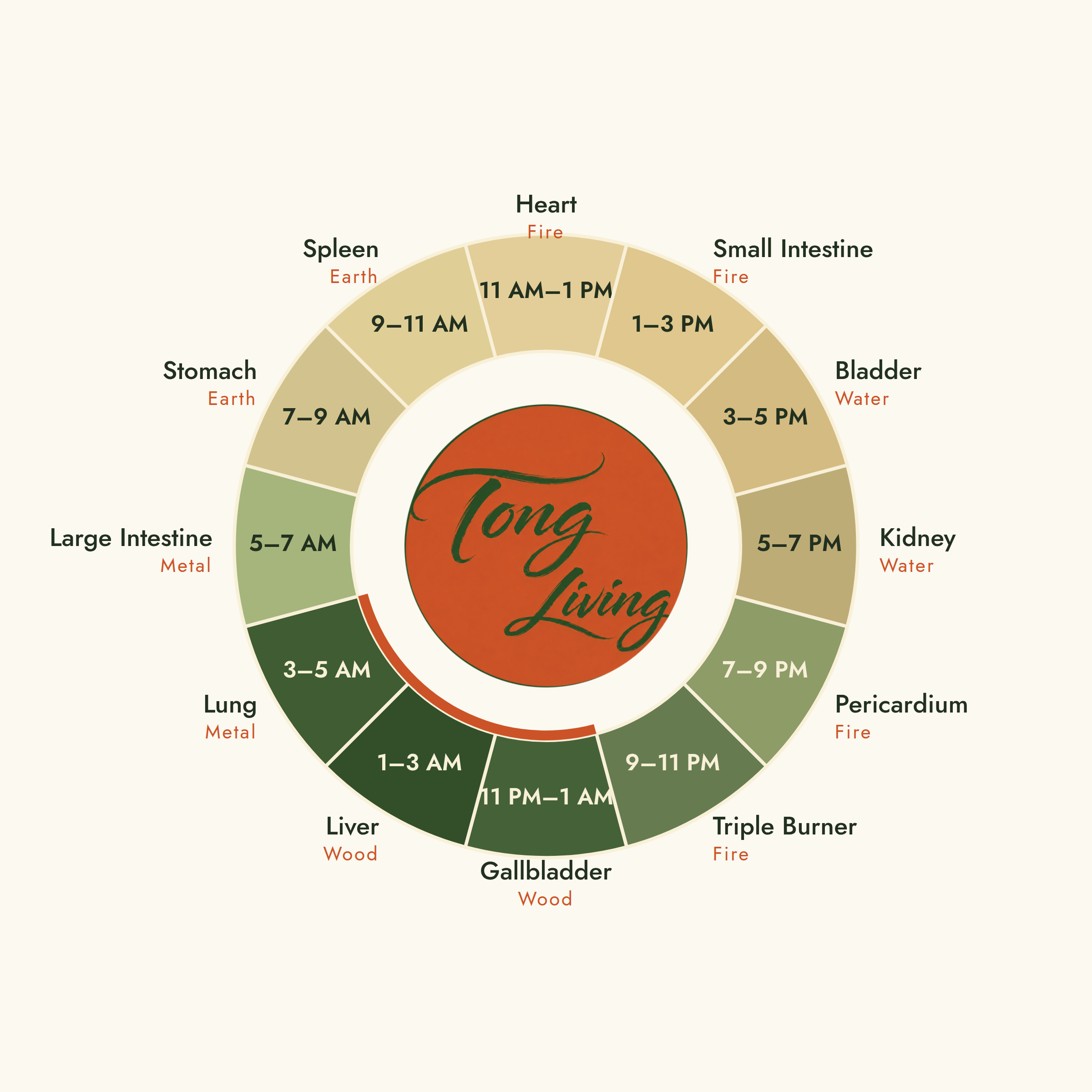
You probably already know one of your hours.
Perhaps it is the wall that arrives at three in the afternoon, no matter how productive the morning was. Perhaps you are tired at nine in the evening and wide awake again at eleven. Or perhaps you wake at almost the same time each night, look at the clock, and wonder why your body is so punctual.
Chinese medicine has a map for these repeated moments. It divides the day into twelve two-hour windows, each traditionally associated with an organ system and a particular kind of work. It is usually called the Chinese medicine body clock or organ clock.
The useful question is not, “How do I make my life obey this clock?” It is, “Where does my day reliably change, and what might that moment help me notice?”
Two kinds of body clock and an important distinction
Modern circadian science shows that the human body is rhythmic. Sleep and wakefulness, hormone release, appetite, digestion, temperature, and alertness all change across roughly twenty-four hours. Light and darkness have the strongest influence, while food, movement, stress, and social timing also matter.
The Chinese medicine organ clock is a different kind of map. It is a traditional observational framework that assigns each two-hour window to an organ system. Modern circadian research does not prove those precise organ assignments, and the two systems should not be presented as though they are identical.
They do, however, begin from a shared and practical observation: your body does not do everything equally well at every hour. Timing changes how a meal, a difficult task, a late screen, or a short walk lands.
That is enough to make the clock useful as a prompt for observation, not as a diagnosis.
You do not need to memorise this list. Read it once, then notice which one sounds familiar.
Morning: release, fuel, and focus
5–7am · Large Intestine Traditionally, this is the window of release and beginning again. Warm water, a little movement, and enough time not to rush can support a gentle start.
7–9am · Stomach This window is associated with receiving nourishment. If breakfast suits you, a warm, substantial meal may give the day a steadier beginning than coffee alone. This is not a universal prescription; appetite, work, medication, and your own pattern still matter.
9–11am · Spleen In Chinese medicine, the Spleen describes transformation: turning food into usable energy and information into understanding. Many people recognise this as a good window for concentrated work.
Midday and afternoon: connection, sorting, and transition
11am–1pm · Heart Traditionally associated with warmth, communication, and connection. This can be a natural time to move from solitary work toward conversation, collaboration, or a shared lunch.
1–3pm · Small Intestine This is described as a sorting window: separating what is useful from what is not. A mild post-lunch dip is ordinary. A dramatic crash is worth observing in context rather than simply overpowering with more caffeine.
3–5pm · Bladder The day begins to turn inward. If your energy drops here, try supporting the transition with water, a brief walk, a few slower breaths, or a quieter task. The answer to a 3pm wall may also be upstream, in sleep, breakfast, lunch, or the pace of your morning.
Evening: storage, calm connection, and wind-down
5–7pm · Kidney This window is traditionally associated with conserving your deeper reserves. It is an invitation to stop spending the day’s energy as though it were unlimited.
7–9pm · Pericardium The quality here is quieter connection: conversation, reading, gentle stretching, music, or peaceful solitude. Less performance; more settling.
9–11pm · Triple Burner The Triple Burner is not an anatomical organ. In Chinese medicine it describes coordination across the body’s systems. This window is the handover into sleep: lower light, fewer inputs, and less unfinished work coming to bed with you.
Night: clearing, renewal, and breath
11pm–1am · Gallbladder 1–3am · Liver 3–5am · Lung
The organ clock places the deepest inward work of the day across these hours. If you wake repeatedly in one of them, treat the time as one clue among many. What happened in the evening? Was there alcohol, a late meal, pain, heat, worry, noise, a child waking, or an irregular schedule? What emotion or thought is present when you wake?
The hour alone cannot tell you what is wrong, and waking at 1am does not diagnose a “Liver problem.” Persistent or suddenly changed sleep has many ordinary and medical causes. If it comes with pain, breathlessness, night sweats, marked low mood, or significant daytime sleepiness, speak with a healthcare professional.
How to use the clock without turning it into another rulebook
Choose one repeated moment, not all twelve windows, and observe it for a week.
Write down four things:
- The time. When does the shift actually begin?
- The quality. Sleepy, wired, foggy, hungry, tense, cold, hot, flat, or restless?
- What came before. Food, caffeine, movement, screens, stress, conversation, and sleep the previous night.
- What helped. Not what should have helped; what visibly changed the experience in your body.
Then make one small adjustment. If three o’clock is difficult, try a ten-minute walk before reaching for coffee. If eleven o’clock brings a second wind, notice the first wave of tiredness and dim the evening before it passes. If you wake at four, do not solve your life at four; leave the phone alone, lengthen the exhale, and look for the pattern in daylight.
One week of honest observation is more useful than one day of perfect compliance.
What the clock can and cannot tell you
The body clock can help you see when your day changes. It can show that a problem you experience in the afternoon may begin in the morning, or that sleep may be shaped by the whole evening rather than by the moment your head reaches the pillow.
It cannot tell you which body is moving through that hour.
Two people can both crash at 3pm for very different reasons. One may be under-fuelled. Another may be mentally overloaded. One may need movement; another may need genuine rest. The clock gives you the time of the turning point. Your wider pattern of sleep, digestion, temperature, emotion, energy, and the season gives it meaning.
That difference is central to Tong Living. A map is useful, but only when it helps you read the body that is actually in front of you.
Begin with your own day
The free Tong Living body clock puts all twelve windows on one page and gives you one practical prompt for each. Start with the hour you already recognise.
The body clock is one tool inside the wider Tong Living method. For the fuller framework, including body patterns, timing, rest, movement, food, emotion, and climate, see Tong Living Everyday Chinese Medicine: for the Way Your Body Works.