
You try the breathing exercise a friend swears by. They say it settles them within minutes. You count carefully, follow every instruction, and feel more tense, more aware of your breath, or simply unchanged.
It is easy to assume you did it wrong. A more useful possibility is that the practice moved in the wrong direction for what your body needed that day.
The short answer
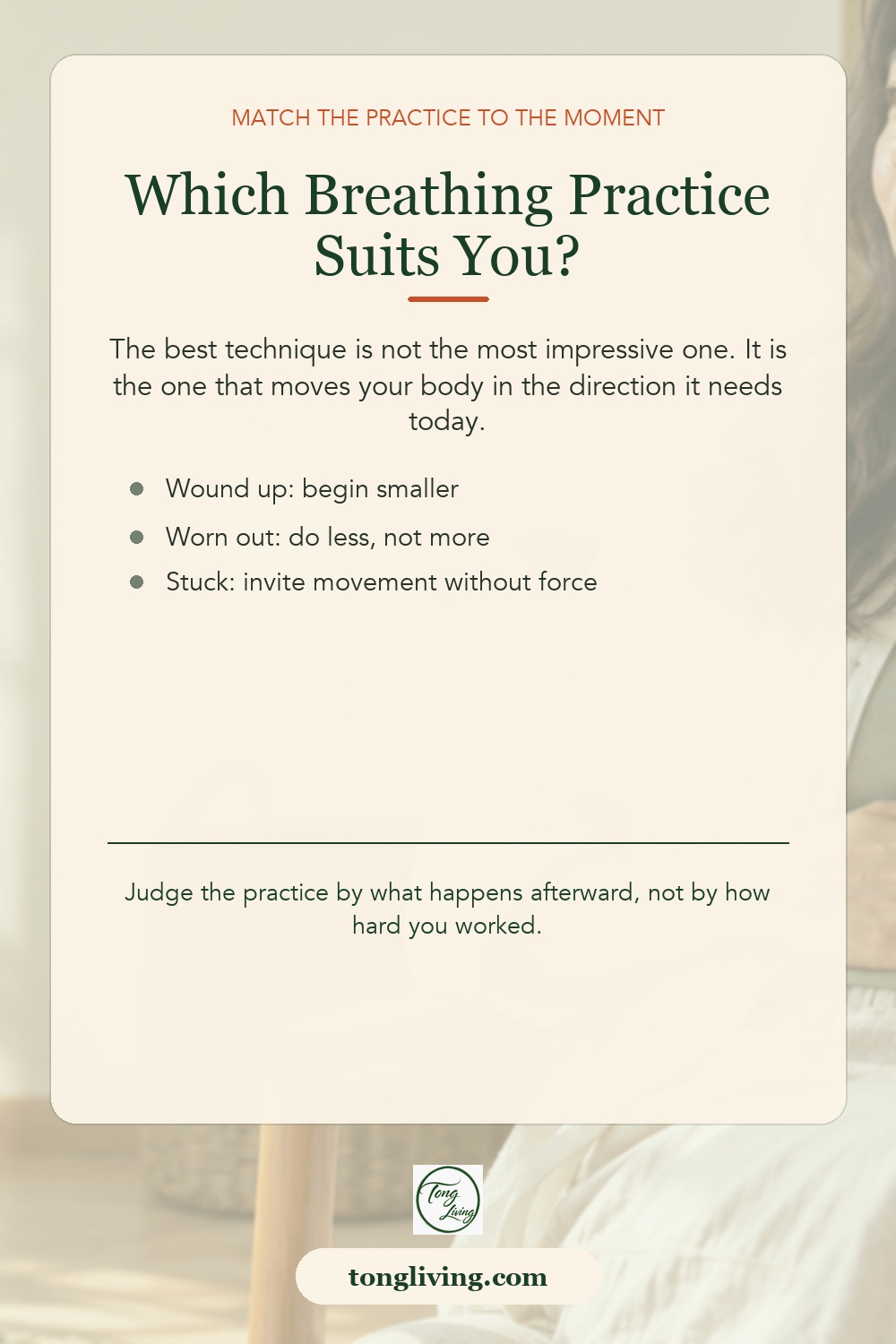
A breathing practice suits you when it moves your body in the direction it currently needs. If you are wound up and braced, you may need less effort and a quieter exhale. If you are worn out, another task to perform may drain you further. If you feel foggy and stuck, movement, humming, or walking may help more than sitting still and controlling the breath.
The same technique can be helpful on Tuesday and unhelpful on Friday because your state has changed. If any practice makes you dizzy, panicky, breathless, or unwell, stop and return to ordinary breathing.
Why does the same breathing technique land differently?
Three things change the result.
First, the state you begin in matters. Wound up is not the same as worn out. Both can produce shallow breathing, but one may contain too much activation while the other has too little available capacity.
Second, notice what your breath is already doing. Is it fast, held, high in the chest, repeatedly interrupted by sighs, or comfortable until you start monitoring it? A technique that adds effort to a breath already working hard may make you feel worse.
Third, be clear about the job. Settling a stressful moment is different from building familiarity with a practice over several weeks. A two-minute experiment can tell you how your body responds now. It cannot prove that one method is your permanent answer.
If you are not sure what stress is doing before you begin, start with the first place pressure tends to show in your body.
What state are you in right now?
These are not diagnoses. They are three plain-language starting pictures.
Wound up
Your jaw may be tight, your shoulders high, your thoughts quick, and your breath fast or held. You have energy, but it is braced and difficult to release.
Worn out
You feel heavy, flat, or hollow. The breath may be shallow because there is not much behind it. You may sigh, but the sigh feels tired rather than relieving.
Stuck
You are restless or foggy and cannot find a useful direction. The breath is neither clearly fast nor slow. Sitting still may make you more aware of the stuck feeling without changing it.
You may recognize two pictures at once, or none. That is information too. Do not force yourself into a category simply to choose an exercise.
| Starting state | What it may feel like | Direction to test |
|---|---|---|
| Wound up | Braced, fast, tight, or held with plenty of activation | Settle with less effort and a quiet, comfortable exhale |
| Worn out | Heavy, flat, hollow, or too depleted for another task | Nourish with rest, warmth, food, or leaving the breath alone |
| Stuck | Restless or foggy, with no useful direction | Move through walking, humming, singing, or gentle stretching |
Which direction does your breath need?
Choose the direction before the technique. Techniques change. The direction is the reasoning underneath them.
If you are wound up, settle
Use less effort, not more. Let the breath stay small and quiet. Soften the jaw, allow an ordinary inhale, and let the exhale finish without pushing it to a target count. If a longer exhale appears comfortably, that may help. If extending it becomes work, shorten it.
If you are worn out, nourish
Do not make breathing another performance. Warmth, food, sleep, or leaving the breath alone may be the better response. A practice that demands concentration can consume the little capacity you are trying to restore.
If you are stuck, move
Try walking, humming, singing, stretching, or gently shaking out the arms. Let the breath follow the body rather than asking the breath to lead. The rest-or-move test uses the same direction logic for physical activity.
“Do nothing to the breath” is a legitimate choice. The point is not to find a breathing exercise for every state. It is to find the response that fits.
Why can a practice stop working?
Your answer moves. Poor sleep, illness, a demanding week, the menstrual cycle, climate, meals, and time of day can all change what your body has available.
You also read yourself differently from inside each state. When you are wound up, everything can look urgent. When you are worn out, everything can look like too much. A familiar method helps because it gives you a question to follow when your own reading is colored by the moment.
There are also more useful responses than the few named techniques that travel widely online. Box breathing, 4-7-8 breathing, and the instruction to “take a deep breath” all ask something specific of the body. If that direction is wrong for you, the conclusion “breathing does not work for me” may be the wrong lesson from accurate feedback.
If deliberate deep breathing has made you dizzy, tight, or panicky, read why a bigger breath can sometimes intensify discomfort before trying another counted practice.
What does Chinese medicine add?
Chinese medicine distinguishes between something constrained and something depleted. From the outside, both can look tired or shallow. They point in opposite directions.
Something constrained may benefit from movement. Something depleted may first need nourishment and rest. Trying to move depletion harder can empty it further. Trying to rest constraint without any release can leave it feeling trapped.
This is a traditional framework, not a biomedical diagnosis. Its practical value is the question it teaches you to ask: is there capacity that cannot move, or is there too little capacity to spend?
That distinction sits inside the wider idea of a changeable body pattern. The language of Qi describes both capacity and activity, which is why “low” and “stuck” do not mean the same thing.
How do you test a practice on yourself?
Try one gentle practice for no more than two minutes. Then stop changing the breath and notice the after-effect.
- More ease, clarity, or steadiness: it may fit your present state. Keep it gentle and check again later.
- More effort, vigilance, or self-consciousness: the direction or timing may be wrong. Stop rather than forcing a result.
- No change: the breath may not be the useful lever. Food, warmth, movement, sleep, or an honest conversation may matter more.
- Dizziness, tingling, panic, unusual breathlessness, or feeling unwell: stop. Return to ordinary breathing and seek appropriate help if symptoms do not settle or concern you.
The after-effect is the data. A practice that stops fitting has not necessarily stopped working. You may have changed.
When is the breath not the answer?
Breathing cannot send the difficult email, change an unsafe situation, reduce an impossible workload, or replace care for a medical problem. Sometimes the body is accurately responding to circumstances that need action.
New or worsening breathlessness needs medical attention, especially when it occurs at rest or with chest pain, fainting, confusion, blue or gray lips or skin, fever, or difficulty speaking. Breathing changes can have many causes, including heart and lung conditions, infection, anemia, and medication effects. Do not interpret a concerning symptom only through a stress or Chinese medicine framework.
What is the best breathing exercise for you?
The most useful question is not which breathing exercise is best. It is which direction you need today, and whether what you tried moved you that way.
Notice your state. Choose one direction. Try less than you think you need. Then check what came back.
For the fuller Tong Living method for reading state, direction, response, and after-effect across breath, food, movement, rest, emotion, and climate, see Tong Living Everyday Chinese Medicine: for the Way Your Body Works.
Sources and further reading
- How Breath-Control Can Change Your Life: A Systematic Review on Psycho-Physiological Correlates of Slow Breathing
- Breathing practices for stress and anxiety reduction: Conceptual framework of implementation guidelines based on a systematic review
- Nonpharmacological Interventions for Dysfunctional Breathing in Adults: A Systematic Review
- Relaxation Techniques: What You Need To Know, National Center for Complementary and Integrative Health
- Breathing difficulty, MedlinePlus Medical Encyclopedia