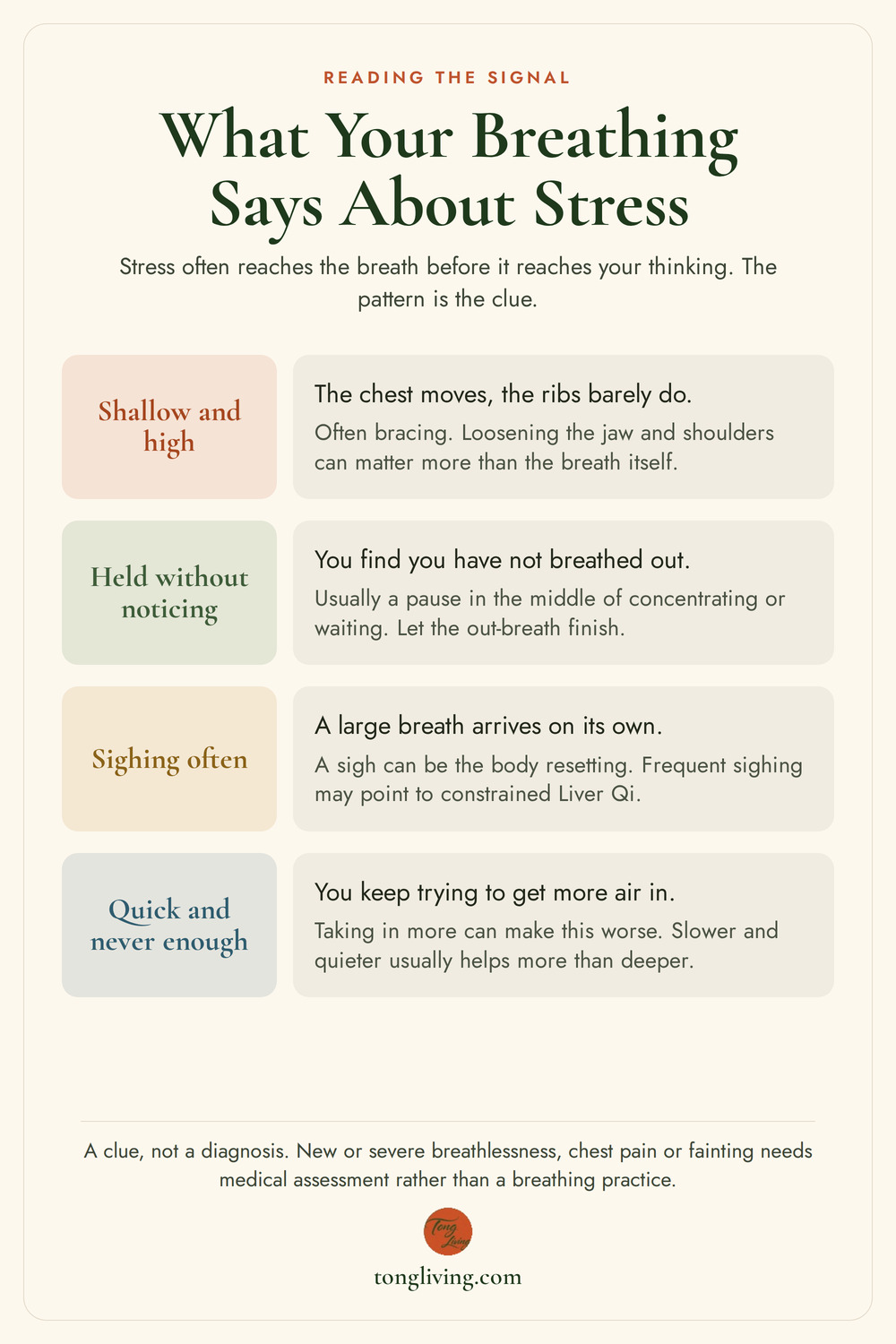

You open a difficult email and realize you have not breathed out. Your shoulders are high, your chest is barely moving and the next breath arrives as a large sigh.
At another time, stress makes the breath quick and obvious. It feels as if you cannot quite get enough air, even though you keep trying to take more in.
These experiences can seem contradictory. How can stress make one person breathe faster, another hold their breath and another sigh repeatedly?
The answer is that stress does not impose one fixed breathing pattern. It changes the conditions in which breathing happens. Your body may prepare for action, brace against something, narrow its attention or try to reset a rhythm that has become irregular. The form this takes depends on the moment, the person and what else is happening in the body.
The short answer
Stress can change breathing because the body's response to demand affects muscle tension, attention and the pace of respiration. Some people breathe faster and higher in the chest. Some pause or hold the breath while concentrating or bracing. Some sigh more often.
These patterns can help you notice when strain is building, but they are not diagnoses. Shallow breathing, breath-holding and frequent sighing can also occur with pain, exertion, habit, anxiety and medical conditions. The useful question is not simply, "Is this stress?" It is: When does the change begin, what comes with it and what changes it?
Why does stress reach the breath so quickly?
Breathing is automatic, but it is also responsive. It changes when you walk upstairs, speak, laugh, concentrate, feel pain or anticipate a difficult conversation.
When the brain detects a demand, the body prepares to meet it. Heart rate, muscle tone, attention and breathing may all shift. The National Institute of Mental Health describes stress as a physical or mental response to an external cause. The response may be useful in the short term, but it becomes harder on the body when it is intense, repeated or never given time to settle.
The breath often reveals this change before you have named the feeling. A jaw tightens. The shoulders rise. The abdomen becomes still. You begin breathing through the upper chest or discover that you have paused halfway through an email.
This is why breathing can be an early signal of stress. It is not because every unusual breath means danger. It is because breathing participates in the body's attempt to respond.
What can shallow or rapid breathing tell you?
Shallow breathing usually means that each breath moves a smaller volume of air. It may also become faster, more noticeable in the upper chest or accompanied by raised shoulders.
Under stress, this can be part of readiness. The body is behaving as if it may need to act. But shallow breathing is not specific to stress. It can also accompany pain, restricted posture, respiratory illness, physical effort or the habit of sitting still for long periods.
Context makes the observation more useful:
- Does it begin when you open your inbox, enter a meeting or think about a particular person?
- Does it come with a tight jaw, racing thoughts, cold hands or stomach tension?
- Does it ease when the task ends, when you stand up or when you feel supported?
- Is it new, persistent or unrelated to anything you can identify?
If the pattern appears reliably with demand and settles when the demand passes, stress becomes a plausible part of the picture. If it is persistent, worsening or accompanied by concerning symptoms, it deserves medical assessment rather than interpretation from a blog article.
Why do I hold my breath when I am stressed?
Many people hold their breath without noticing. It can happen while lifting something heavy, waiting for bad news, concentrating on a precise task or trying not to react.
Sometimes the pause is only a second. You freeze over the keyboard, grip the mouse or read the same sentence three times. Then the body releases the pause with a larger breath.
Breath-holding can be understood as a form of bracing. The body momentarily becomes still while attention narrows. That does not mean the response is always harmful. A short pause is part of normal breathing and normal effort. The useful clue is repetition: are you spending much of the day moving from one small brace to the next?
Notice what you are doing immediately before the pause. Is it the difficult part of the task, the moment before you speak, the second you anticipate criticism or the point at which you decide to swallow what you wanted to say?
That sequence tells you more than the held breath alone.
Why do I sigh so much when I am stressed?
A sigh is a larger breath that interrupts the ordinary pattern. It is normal physiology, not automatically evidence of anxiety or poor breathing.
Research suggests that sighs help restore variability in breathing and may play a role in transitions between states. In ordinary language, a sigh can accompany relief, frustration, boredom, longing or the release of effort. The same visible act can belong to very different experiences.
Frequent sighing has also been observed alongside anxiety and panic. That association does not mean a sigh diagnoses either condition. Researchers are still examining how sighing, respiratory regulation and emotional state influence one another.
Instead of asking, "Why am I sighing so much?" in isolation, ask:
- What happens in the minute before the sigh?
- Does it feel relieving or does it make you chase another large breath?
- Does it occur during one task, after conflict or when you finally stop?
- Is it accompanied by dizziness, tingling, air hunger, chest discomfort or fear?
A relieving sigh after a long concentration period is different from repeated large breaths that leave you light-headed and unable to feel satisfied.
Is a breathing pattern one sign or a sequence?
Suppose you notice that your breathing becomes shallow during an afternoon meeting. That observation is useful, but incomplete.
Perhaps you skipped lunch, drank another coffee and entered the meeting already tired. Your shoulders rose when a difficult subject came up. You held the breath while deciding whether to disagree, then sighed when someone changed the topic. The breathing pattern is one part of a larger sequence involving energy, emotion, posture, timing and expression.
This is the practical meaning of a body pattern. It is not a label attached to one symptom. It is a relationship between signs that becomes clearer when it repeats. The article on what Chinese medicine means by your body pattern explains why timing and context matter more than matching one sign to a diagnosis.
If you want to see how breathing fits into the wider stress response, the physical signs of stress can help you read the jaw, shoulders, digestion, sleep and energy as part of the same developing sequence.
What does Chinese medicine add?
Chinese medicine pays close attention to movement, rhythm and the relationship between emotion and bodily function.
The Lung functional system is traditionally associated with respiration and the movement and distribution of Qi. Stress may also be described through constraint: something that should move freely becomes held, tight or irregular. Sighing can be considered alongside that constraint because it may feel like an attempt to create movement or release.
This is a traditional framework, not a biomedical claim that one anatomical organ causes stress or that a practitioner can diagnose you from a sigh. Its practical value is in the questions it encourages:
- Where is movement restricted?
- What are you bracing against?
- Does the breath change before or after the emotion becomes conscious?
- What restores movement without forcing it?
Qi in this context is not a mysterious substance that can be measured from one breath. It is a way of thinking about function, movement and relationship. This explanation of Qi in Chinese medicine develops that idea in everyday terms.
Should I notice the breath before I try to fix it?
Breathing advice often begins with a technique. Count to four. Fill the abdomen. Make the exhale longer. Take a deep breath.
Those instructions may help, but observation should come first. If you do not know whether you are rushing, holding, forcing or monitoring the breath, a technique can add another demand without answering the problem.
For three days, try a small observation instead.
1. Catch the first change
You do not need to monitor every breath. Notice the first moment the breath becomes obvious. Perhaps you sigh, lift the shoulders, stop breathing briefly or feel the urge to take a large inhale.
2. Name what happened just before it
Write one plain sentence: "I was reading a message from…" "I was trying not to interrupt…" "I had been sitting for two hours…" "I was rushing because…"
3. Add one companion sign
Choose the clearest one: jaw tension, stomach tightness, racing thoughts, cold hands, headache, fatigue or nothing else you can detect.
4. Notice what changes the pattern
Does it ease when you move, finish the task, speak honestly, eat, rest, step outside or talk to someone? Does deliberate breathing help, make no difference or make you more self-conscious?
The aim is not to produce perfect breathing. It is to find the conditions in which your breathing changes.
Can breathing settle stress without removing its source?
A slow walk, a softer exhale, music or yoga may help the body release what has accumulated. That relief is real.
But if the breath tightens again when you return to the same workload, relationship or unspoken worry, the returning stress does not prove that the practice failed. Settling the response and changing its source are different jobs.
Why stress comes back after you relax explains this distinction. Small resets during the day can keep tension from accumulating, while practical changes, honest expression, boundaries or professional support address what keeps creating it.
The breath can show you where the sequence begins. It cannot send the email, change the deadline or say the thing you have been holding in.
When do breathing changes need medical attention?
Do not assume new or persistent breathing difficulty is caused by stress. Shortness of breath has many possible causes, including heart and lung conditions, infection, anemia and other medical problems.
Seek urgent medical help for sudden or severe difficulty breathing, chest pain or pressure, fainting, confusion, blue or gray lips or skin, or breathlessness so severe that speaking is difficult. New, worsening or unexplained breathlessness, wheezing, palpitations, dizziness or symptoms that interfere with ordinary activity should be assessed by a healthcare professional.
If fear, panic or anxiety is persistent, worsening or affecting daily life, a qualified mental health professional or doctor can help. Breathing practices may support care, but they are not a substitute for diagnosis or treatment.
What can I learn from the way I breathe?
The breath is easy to turn into another standard you must meet. It should be slow. It should be deep. It should prove that you are calm.
A more useful approach is to let it be information.
Shallow breathing may tell you that effort is rising. A held breath may reveal a moment of bracing. A sigh may mark relief, frustration or an attempt to reset. None of these meanings should be imposed in advance. Watch the sequence and let the repeated context show you what the change belongs to.
For the fuller Tong Living method for reading breathing together with stress, sleep, digestion, movement, timing and your current pattern, see Tong Living Everyday Chinese Medicine: for the Way Your Body Works.
Sources and further reading
- I'm So Stressed Out!, National Institute of Mental Health
- Relaxation Information Pack, Norfolk and Norwich University Hospitals NHS Foundation Trust
- The psychophysiology of the sigh: II. The sigh from the psychological perspective
- The Integrative Role of the Sigh in Psychology, Physiology, Pathology, and Neurobiology
- Therapeutic effects of voluntary slow breathing in conditions of pathological stress
- Breathing practices for stress and anxiety reduction: Conceptual framework of implementation guidelines based on a systematic review of the published literature
- Breathing difficulty, MedlinePlus Medical Encyclopedia
- Shortness of breath, NHS