
Stress does not always arrive as the thought, “I am stressed.”
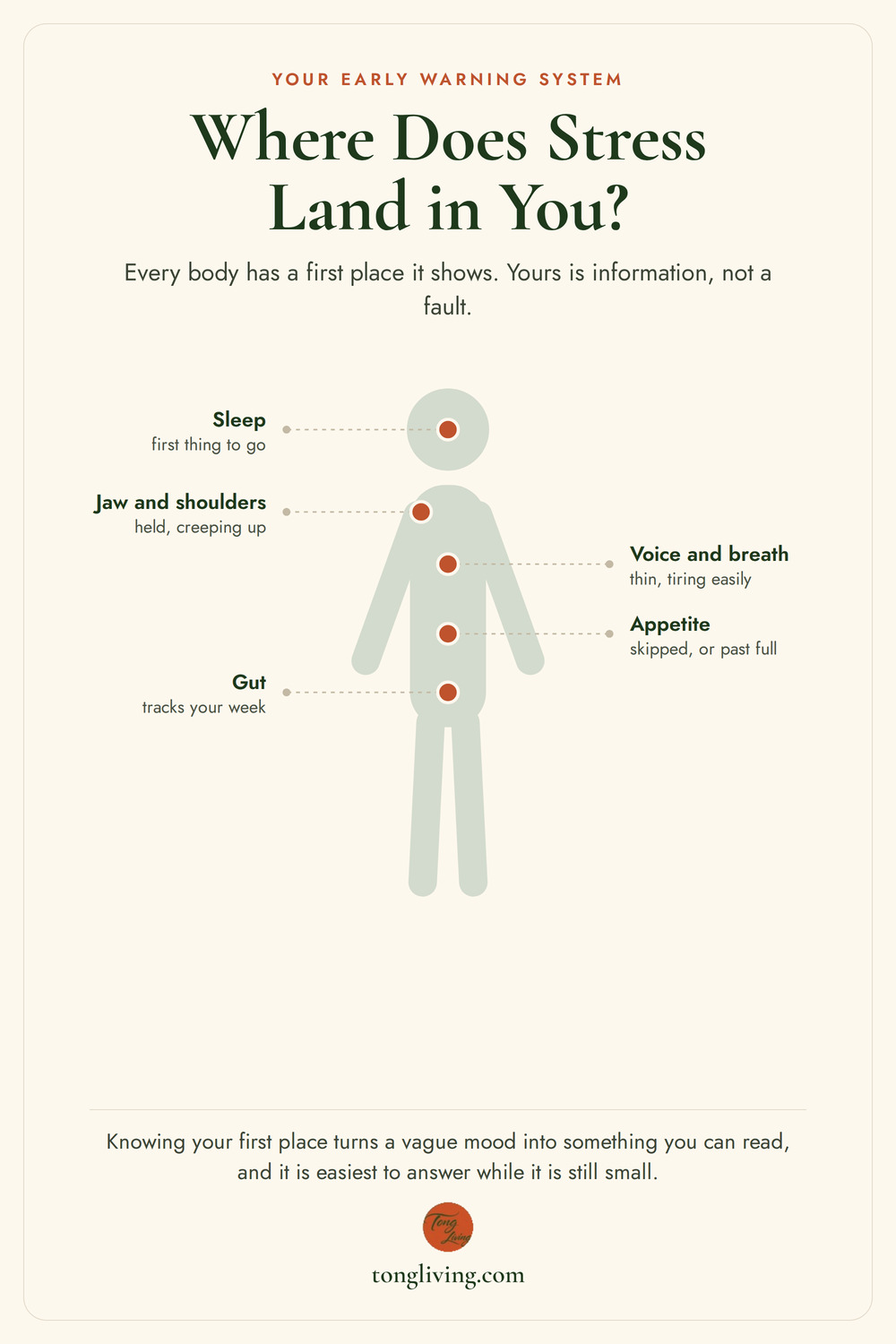
It may arrive as teeth pressed together while you answer an email. Shoulders that have crept toward your ears. A stomach that tightens before a difficult conversation. A breath held so quietly that you notice it only when you finally sigh. You may become restless, unable to settle, or so tired that everything feels heavy.
These physical changes are real. They do not prove that stress is the only cause, and their location does not provide a diagnosis. They are clues. What makes them useful is the sequence around them: what happened beforehand, which other changes appeared, whether they ease when the situation passes and whether the same pattern keeps returning.
The short answer
Stress is a physical as well as an emotional response to challenge. It can change muscle tension, breathing, heart rate, digestion, sleep, concentration and energy. One person notices a tight jaw first. Another loses their appetite. Someone else becomes tired, headachy, restless or unable to sleep.
The place where you notice stress is therefore less like a fixed emotional code and more like your body’s early warning light. It tells you that something has changed. You still need context to understand what the change may mean.
Why a mental load can become a physical feeling
When the brain detects a demand or threat, the body prepares to respond. The stress response can increase alertness, change breathing and heart rate, tense muscles and temporarily alter functions such as digestion. This response can be useful when action is needed.
The difficulty comes when the activation is repeated, lasts too long or has no clear outlet. A deadline ends, but another begins. A conversation is postponed, but the body continues rehearsing it. Muscles remain guarded. Sleep becomes lighter. Digestion becomes more sensitive. Fatigue accumulates beneath the effort required to keep going.
This does not mean every headache, stomach problem or poor night of sleep is caused by stress. The same symptom can have many causes. Stress is one possible part of the picture, especially when the symptom reliably rises and falls with pressure, conflict, uncertainty or overload.
Five common ways stress may appear physically
1. Your muscles brace
Muscle tension is one of the most recognisable physical responses to stress. You may clench your jaw, raise your shoulders, stiffen your neck, grip your hands or hold your body in a posture that feels ready for impact.
The first sign may be surprisingly small: your teeth touch when they normally would not, your tongue presses against the roof of your mouth, or you realize that you have been leaning toward the screen for twenty minutes.
Tension in the neck, shoulders and head can accompany tension-type headaches, but pain that is new, severe, persistent or worsening should not simply be labeled stress.
2. Your breathing and heartbeat change
Some people notice that their breathing becomes faster, shallower or interrupted by frequent sighs. Others become aware of a pounding or faster heartbeat, sweating, trembling or a feeling of pressure.
If breathing is the first place you notice the change, why stress changes your breathing separates shallow breaths, sighing and breath-holding, and explains when those changes need medical care.
These sensations can occur during stress or anxiety, but they can also occur with medical problems. New chest pain, severe breathlessness, fainting, or chest pressure that spreads to the arm, jaw or back needs urgent medical assessment. Do not wait to see whether relaxation makes it disappear.
3. Your digestion responds
The brain and digestive system communicate continuously. During a stressful period, you may lose your appetite, eat more quickly, feel nauseated, notice bloating or discomfort more readily, or experience a change in bowel habits.
If the problem follows particular meals as well as stressful situations, both parts deserve attention. The article on why healthy food can still leave you bloated explains how portion, preparation, timing, digestion and stress can overlap without reducing the answer to one ingredient or “just anxiety.”
Persistent digestive symptoms, unexplained weight loss, blood in the stool, repeated vomiting, severe pain or difficulty swallowing require medical advice.
4. Sleep stops feeling like a clean switch
Stress can make it difficult to fall asleep, wake you during the night or leave a tired body feeling strangely alert. Sometimes the body is depleted while the mind remains mobilized, rehearsing what happened or preparing for tomorrow.
If that description feels familiar, why you can feel tired but unable to sleep looks more closely at the difference between tiredness and the ability to settle.
5. Your energy and attention change
Stress does not always feel fast. It can also appear as fatigue, fogginess, poor concentration, irritability or the sense that an ordinary decision requires too much effort.
This matters because a depleted response needs a different kind of support from a tightly wound one. More stimulation may briefly lift exhaustion while increasing the activation underneath it. Forced rest may frustrate someone whose body needs a short transition through movement before it can settle.
The physical sign is only the first clue. Its quality helps you decide what to observe next.
What Chinese medicine adds
Traditional Chinese medicine often describes stress through the movement of Qi. The Liver functional system is associated with smooth movement, responsiveness and the capacity to adjust. When that movement becomes constrained, the traditional description is Qi stagnation.
This is a traditional framework, not a biomedical claim that a measurable substance is trapped in your shoulders or that tension means there is something wrong with the anatomical liver.
Its practical value is the question it asks: Where has movement become restricted, and what else changed with it?
For one person, pressure appears as a tight jaw, raised shoulders, irritability and a need to move. For another, worry turns circular and digestion becomes unsettled. Someone else loses sleep, becomes hot and restless, or moves from prolonged tension into exhaustion. Chinese medicine does not treat those as interchangeable simply because all three people use the word “stress.”
This is why reading the wider body pattern matters more than assigning a fixed meaning to one body part. Location is useful, but timing, temperature, digestion, sleep, energy, emotion and response to change make the picture more specific.
Do not turn the body into a rigid emotion map
It is tempting to decide that jaw tension always means suppressed anger, stomach discomfort always means worry or shoulder pain always means carrying too much responsibility. Those explanations may sometimes feel personally meaningful, but the location alone cannot establish them.
A clenched jaw may accompany stress, concentration, pain, a dental problem or sleep bruxism. Tight shoulders may reflect workload, posture, vision strain, injury, cold or several factors together. A stomach change may follow stress, food, infection, medication or an underlying digestive condition.
Use the signal to open a question, not close one.
Read the sequence, not only the symptom
For five ordinary days, choose one physical sign that you notice repeatedly. Do not monitor your whole body all day. That can create more tension rather than useful awareness.
When the sign appears, record five details:
- What happened just before it? A meeting, a meal, focused work, caffeine, rushing, conflict, bad news or nothing obvious?
- What was the first change? Jaw, shoulders, breath, stomach, heartbeat, temperature, energy or thought speed?
- What came with it? Irritability, worry, hunger, pain, cold hands, headache, fatigue or difficulty concentrating?
- What changed it? Movement, food, rest, finishing the task, speaking honestly, leaving the room, company or time?
- What remained afterwards? Did the body settle while the practical problem stayed, or did the whole experience pass?
This separates a vague state from a repeatable pattern. You may discover that the jaw tightens before you consciously recognize frustration, that stomach discomfort follows rushed meals during pressured afternoons, or that your “sudden” evening exhaustion began with shallow breathing hours earlier.
If yoga, music, walking or meditation brings relief but the stress returns, the article on why stress comes back after you relax explains why temporary relief can be real even when the source still needs another response.
Let the first signal guide a small response
The aim is not to decode your body perfectly. It is to catch the change early enough to make a proportionate choice.
- If you are braced and restless, a brief walk, stretch, slower exhale or change of position may give the activation somewhere to go.
- If you are depleted, shaky or running on caffeine, food, water, warmth or genuine rest may be more appropriate than pushing harder.
- If the physical reaction follows an unfinished practical problem, write down the next action, ask for help or have the conversation the calming technique cannot have for you.
- If the symptom is persistent, unexplained or concerning, arrange assessment rather than building a self-care theory around it.
Notice the after-effect. A fitting response usually gives you a little more ease, clarity or capacity. If an action repeatedly leaves you more agitated, more exhausted or no closer to functioning, that result is information too.
When stress needs more than observation
Self-observation is not a substitute for healthcare or mental health support.
Speak with a qualified professional if stress or anxiety feels unmanageable, is always present, interferes with work, sleep, relationships or ordinary life, or is accompanied by panic, depression, substance use or physical symptoms that concern you.
Seek urgent help for chest pain or pressure, severe difficulty breathing, fainting, sudden weakness, confusion, thoughts of harming yourself or another symptom that may represent an emergency. A symptom should not be assumed to be stress simply because it appeared during a difficult period.
Your earliest sign is useful information
The body often speaks before the mind has finished explaining. A held breath, tightening jaw, unsettled stomach or sudden drop in energy can tell you that your state has changed.
Do not ask the signal to diagnose you. Ask it to help you notice sooner.
Where did the change begin? What happened around it? What travels with it? What eases it, and what remains unresolved? Those questions turn “stress is everywhere” into something more workable: a pattern you can observe, respond to and discuss clearly when you need support.
For the fuller Tong Living method for reading emotion together with sleep, digestion, movement, food, timing and your current pattern, see Tong Living Everyday Chinese Medicine: for the Way Your Body Works.
Sources and further reading
- Stress effects on the body, American Psychological Association
- I’m So Stressed Out!, National Institute of Mental Health
- Manage Stress, MyHealthfinder, U.S. Office of Disease Prevention and Health Promotion
- Traditional Chinese Medicine: What You Need to Know, National Center for Complementary and Integrative Health