“Take a deep breath” sounds like the simplest advice in the world.
For some people, it helps. The shoulders soften, the pace slows and there is a little more room between the feeling and the reaction.
For others, the opposite happens. The breath feels too large or effortful. The chest becomes more noticeable. Light-headedness, tingling or a sense of not getting enough air appears. Counting creates another task to perform correctly. Focusing on breathing makes anxiety louder rather than quieter.
That does not necessarily mean breathing practices are useless for you. It may mean that “deep” has been interpreted as big, forceful or controlled, when what your body needs is something softer.
The short answer
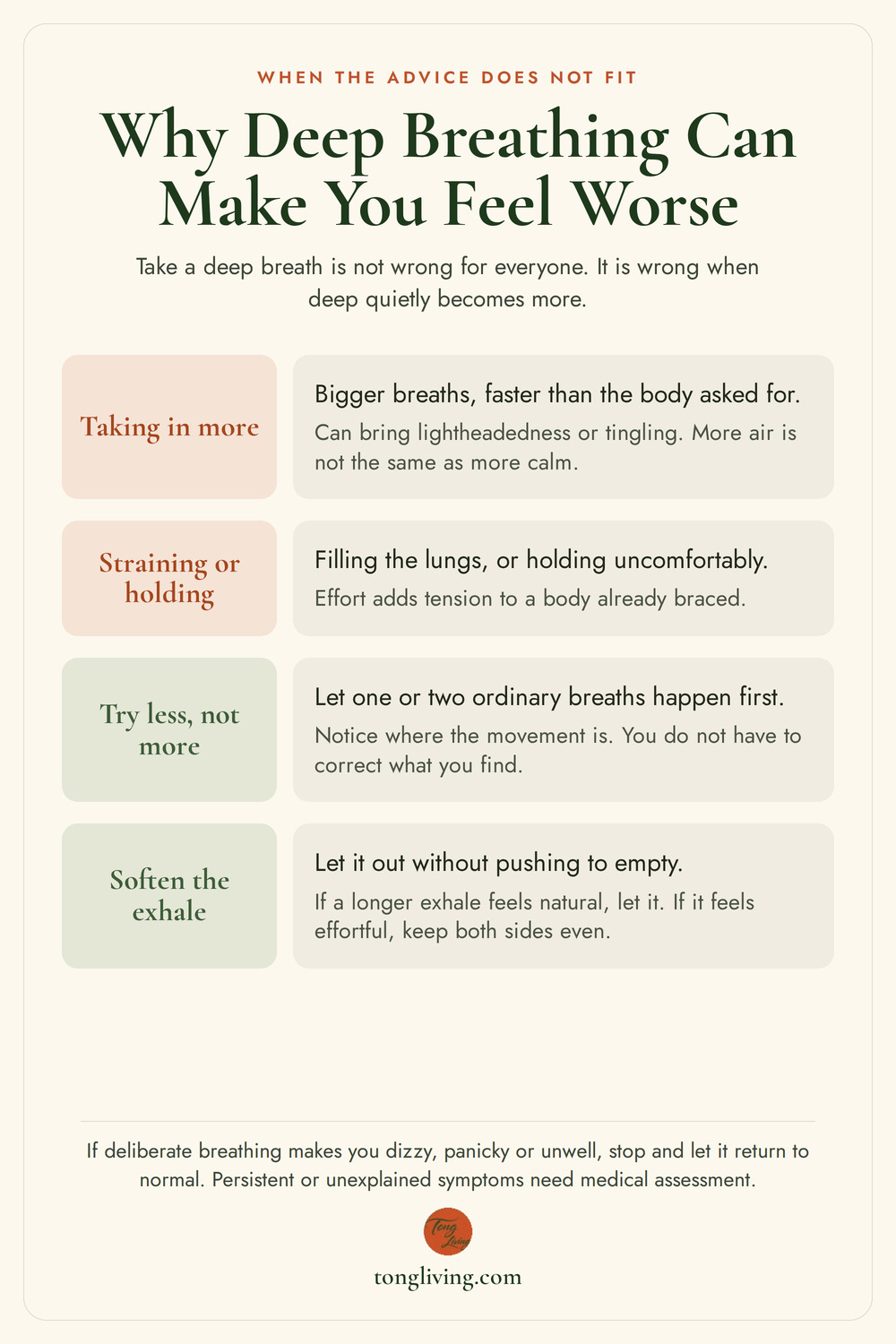
Deep breathing can feel worse when you take in more air than your body needs, breathe too quickly, strain to fill the lungs, hold the breath uncomfortably or become more alarmed by the sensations you are monitoring.
The useful change is often not to breathe as deeply as possible. It is to let the breath become quieter, slower and easier without forcing it.
If deliberate breathing makes you dizzy, panicky, breathless or unwell, stop changing it and allow it to return to normal. Persistent or unexplained symptoms need medical assessment, especially when they include chest pain, fainting or significant difficulty breathing.
Why can “deep” accidentally become “more”?
Breathing is both automatic and partly voluntary. That makes it unusual: you can observe it, influence it and also interfere with it.
When someone says “take a deep breath,” many people lift the chest, pull in a very large inhale and repeat it. If the breaths are bigger or faster than the body requires, you may begin to over-breathe. This can lower carbon dioxide in the blood and produce sensations such as light-headedness, tingling, weakness, palpitations or a feeling of unreality.
Those sensations can be frightening. If you are already anxious, noticing them may confirm the fear that something is wrong, which can lead to another large breath and another round of symptoms.
This is one reason “more air” is not always the same as “better breathing.” A calm breath does not need to be impressive. It may be so small that nobody else can see it.
Why can focusing on the breath increase anxiety?
Not every uncomfortable response comes from over-breathing. Attention itself can change the experience.
If you are worried about your heart, lungs, dizziness or losing control, turning all your attention toward the breath may make ordinary sensations feel more urgent. Counting can create pressure. Breath holds can feel like restriction. An instruction that is supposed to calm you becomes another test you might fail.
Relaxation practices are generally considered safe for healthy people, but the National Center for Complementary and Integrative Health notes that some people report increased anxiety, intrusive thoughts or fear of losing control. This does not make the reaction imaginary. It means the same practice does not produce the same experience in every nervous system or every situation.
If close attention to breathing makes you spiral, begin somewhere more neutral. Feel your feet on the floor. Look around the room. Notice three sounds. Walk slowly. Let the breath remain automatic while the rest of the body receives the message that it does not have to perform.
Can slow breathing help without being forced?
Research on breathwork is promising but not a license to make universal claims. A meta-analysis of randomized controlled trials found small-to-medium improvements in stress and mental health, while also warning that the evidence needs cautious interpretation. In other words, breath practices can be useful, but they are not a guaranteed switch and they are not all equivalent.
Slow breathing appears to be one helpful feature. A randomized study found that five minutes of slow breathing reduced psychological stress. However, extending the exhale did not produce a statistically significant advantage over an equal inhale and exhale.
That matters because “make the exhale longer” is often presented as if it is the only correct method. A slightly longer exhale may feel settling for some people. For others, it creates strain or a sense of running out of air. The better starting point is the rhythm you can follow comfortably.
Comfort is not a lesser version of the practice. It is part of the information.
What does Chinese medicine add?
In Chinese medicine, breathing belongs to a wider picture of Qi, rhythm and the body’s capacity to receive and release.
The Lung functional system is traditionally associated with respiration and the movement and distribution of Qi. This is a traditional organizing framework, not a claim that the anatomical lungs control every experience of anxiety or that a breathing problem can be diagnosed from one sensation.
The useful question is not simply, “How do I make this breath deeper?” It is:
What is the breath doing now, and what happens when I interfere with it?
Is it held while you concentrate? Fast when you feel threatened? Tight in the chest after rushing? Difficult to slow when you are angry? Quiet but comfortable when you finally lie down? Does deliberate control create ease, effort or more vigilance?
This is the same practical approach described in what Chinese medicine means by your body pattern. One sign becomes more useful when you read it alongside timing, temperature, digestion, sleep, emotion, energy and what changes it.
If the language of Qi feels vague, this practical explanation of Qi shows how movement, function and relationship can be observed without turning the idea into something mystical.
Should I try less effort before a stronger technique?
If you are otherwise well and want to explore a gentler breath, begin by removing the demand to breathe deeply.
1. Notice before changing
Let one or two ordinary breaths happen. Where do you feel movement? Nose, chest, ribs, abdomen or nowhere obvious? Is the breath comfortable, held, hurried or already trying to obey you?
You do not need to correct what you find.
2. Make the next exhale easy
Allow the breath out without pushing it to empty. Think of softening rather than squeezing. Let the next inhale arrive by itself.
If a longer exhale feels natural, let it be slightly longer. If it feels effortful, keep the inhale and exhale similar. Do not chase a particular count.
3. Keep the breath smaller than your ambition
The practice should not require the largest breath you can take. Aim for quiet and unforced. If you notice shoulder lifting, gulping, repeated yawning, dizziness, tingling or air hunger, stop the deliberate pattern and return to normal breathing.
4. Let another part of the body help
Unclench the jaw. Drop the shoulders. Feel the chair supporting you. Look at something steady in the room. Sometimes the breath becomes easier when it is no longer carrying the whole job of calming you.
5. Check the after-effect
After a minute, ask what changed. Do you feel more settled, clearer, sleepier, more alert, more uncomfortable or simply the same?
The answer is not a grade. It tells you whether this version of the practice fits your present state.
Can breathing settle the response without solving the source?
A softer breath can change what is happening now. It cannot send the difficult email, change an impossible workload, repair a relationship or make an unsafe situation safe.
This is why relief may be genuine and still temporary. The article on why stress comes back after you relax separates two different jobs: settling what has accumulated and changing what keeps creating it.
It also helps to notice your earliest physical signal. If the held breath arrives with a tightening jaw, rising shoulders, stomach tension or racing thoughts, the physical signs of stress can help you read the sequence rather than treating breathing as an isolated problem.
The breath is a useful doorway. It is not responsible for fixing every room in the house.
When should I stop a breathing exercise?
Do not continue a breathing exercise that makes you markedly dizzy, faint, panicky, breathless or unwell. Return to normal breathing and rest in a safe position.
Seek medical advice for persistent or unexplained dizziness, breathlessness, palpitations or other concerning symptoms. New or severe chest pain, fainting, blue or gray lips, confusion or significant difficulty breathing needs urgent medical attention.
Breathing practices are not a substitute for assessment or treatment of anxiety disorders, asthma, heart or lung conditions, dysfunctional breathing or other health problems. If anxiety is persistent, worsening or interfering with daily life, a qualified healthcare or mental health professional can help you choose support that does not rely on forcing yourself through a technique that feels wrong.
Does a calmer breath have to be a deeper breath?
The instruction “take a deep breath” makes it sound as if calm is hidden at the bottom of the lungs and you only need to reach far enough.
Often the more useful shift is smaller: notice the breath you have, remove unnecessary effort and see whether ease appears when you stop trying to manufacture it.
If the breath becomes softer, that is enough. If it does not, you have not failed. You have learned that your body may need a different entrance: movement, grounding, expression, practical change, rest or professional support.
For the fuller Tong Living method for reading breathing together with stress, sleep, digestion, movement, timing and your current pattern, see Tong Living Everyday Chinese Medicine: for the Way Your Body Works.
Sources and further reading
- Relaxation Techniques: What You Need To Know, National Center for Complementary and Integrative Health
- Effect of breathwork on stress and mental health: A meta-analysis of randomised-controlled trials
- Brief structured respiration practices enhance mood and reduce physiological arousal
- Slow breathing for reducing stress: The effect of extending exhale
- Breathwork interventions for adults with clinically diagnosed anxiety disorders: A scoping review
- Hyperventilation syndrome, Royal Berkshire NHS Foundation Trust