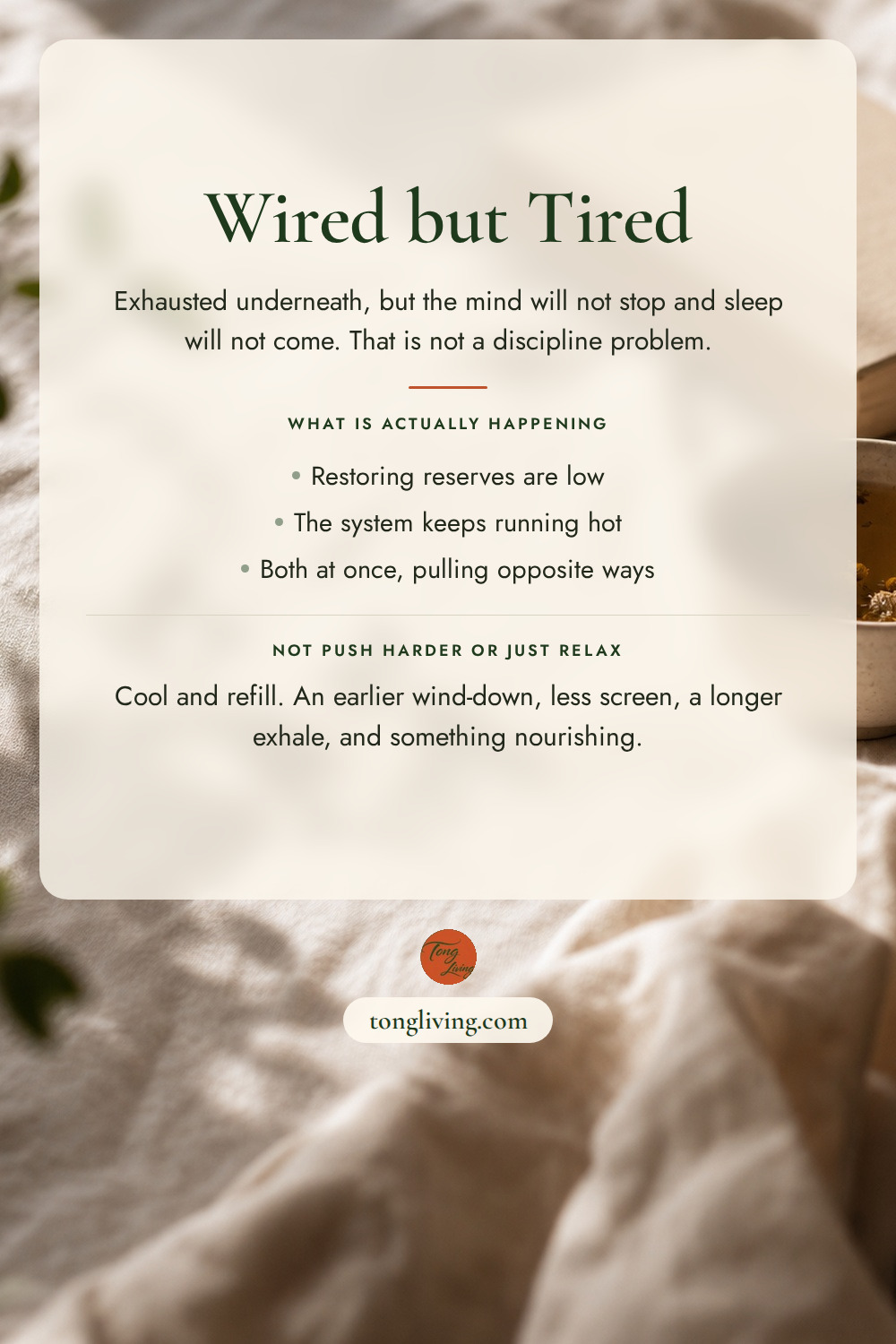
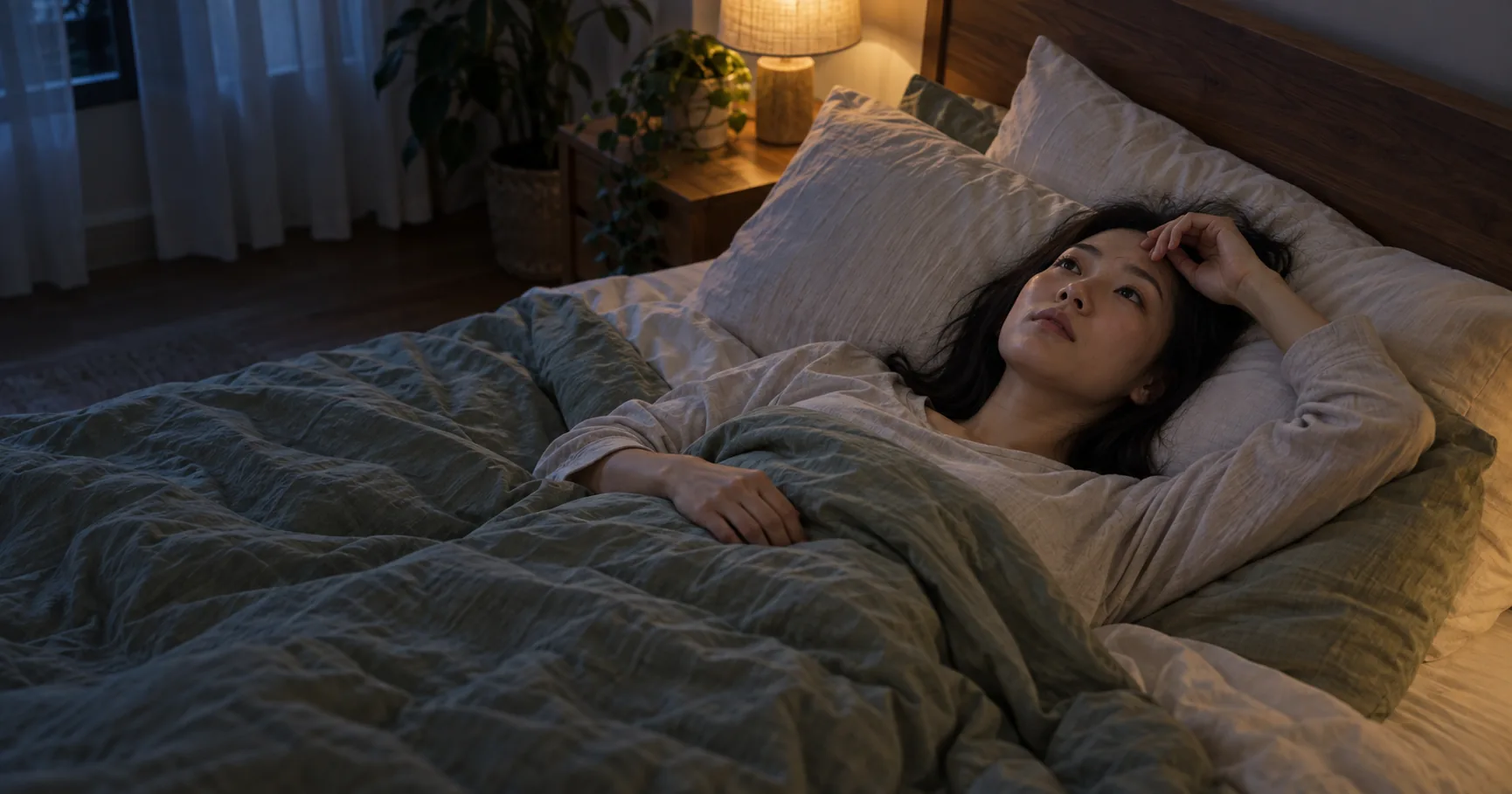
You can be genuinely tired and still not be ready for sleep.
Tiredness describes how used up you feel. Sleepiness is the body’s tendency to cross into sleep. They often arrive together, but not always. A long or stressful day can leave you depleted while your mind remains watchful, your muscles remain braced, your body clock still favors wakefulness, or physical discomfort keeps asking for attention.
This is why “try to relax” can feel both obvious and impossible. The problem may not be a lack of tiredness. It may be that one part of the system has not received the conditions it needs to settle.
The useful question is not only, “How do I make myself sleep?” It is:
What is still active when the rest of me feels tired?
That question does not diagnose insomnia. It does help separate several experiences that can feel identical at midnight but need different responses.
When does persistent sleep difficulty need medical attention?
An occasional difficult night can follow stress, travel, illness, a late coffee, an unfamiliar room, pain, a disrupted schedule, or simply a day that did not end cleanly. One night does not establish a sleep disorder.
Speak with a healthcare professional when difficulty falling or staying asleep happens regularly, lasts for months, or affects concentration, mood, work, driving, relationships, or daily functioning. The National Heart, Lung, and Blood Institute defines chronic insomnia as difficulty sleeping at least three nights a week for three months or longer, when there is adequate opportunity to sleep.
Arrange an earlier assessment when breathing appears to stop during loud snoring; you wake choking or short of breath; uncomfortable sensations make you need to move your legs; you doze unintentionally; daytime sleepiness becomes severe; or new pain, breathlessness, marked mood changes, or another concerning symptom appears. Medicines, menopause, thyroid problems, sleep apnea, restless legs syndrome, mental-health conditions, and other health problems can all affect sleep.
Do not use a Chinese medicine pattern, a body-clock interpretation, or an online sleep routine to explain away a problem that needs ordinary medical assessment.
Why can you be tired without feeling sleepy?
Sleep is not simply what happens when your energy reaches zero.
A biological pressure for sleep generally builds while you are awake. At the same time, your circadian system helps organize when the body supports alertness and when sleep becomes easier. Light and darkness have the strongest influence on that timing, while food, activity, stress, social schedules, and temperature can also affect circadian rhythms.
That means you can have plenty of accumulated tiredness while your internal timing or level of arousal still supports wakefulness. The existing article on a late-night second wind explains one version of this conflict: you felt sleepy, continued through the signal, and became alert again.
But many tired-and-awake nights do not include a second wind. You may never have felt sleepy. You may feel physically heavy but mentally fast. You may be calm in your thoughts but too hot, hungry, uncomfortable, or restless to settle. The distinction matters because “tired but awake” is an experience, not one cause.
What may still be active when you are tired but awake?
Instead of treating the whole night as one problem, ask where the wakefulness is happening.
1. Your timing is still saying daytime
Perhaps you slept late, napped, traveled, worked shifts, spent the evening in bright light, or tried to go to bed much earlier than usual. Your preferred bedtime and your internal timing may not currently agree.
This version can feel surprisingly calm. You are worn out by the day, but not necessarily anxious. Your eyes may be open without effort. If you get up, you may feel capable of reading, working, or talking even though you know you need rest.
Notice whether the difficulty appears at a similar time and whether it changes with your waking time, morning light, naps, travel, or days off. The Chinese medicine body-clock guide explains how to observe repeating timing without pretending that a clock can diagnose the cause.
2. Your mind or muscles are still mobilized
The day may be over on the calendar but still happening in the body. Your jaw is clenched. Your shoulders are raised. Your breathing is small. You rehearse a conversation, solve tomorrow, or listen for the next demand.
This is not imaginary wakefulness. Stress can leave a tired person activated. A yoga session, walk, piece of music, or slow exhale may genuinely lower that activation, but relief can be temporary when the stressor or the way you meet it remains. Why stress can return after you relax develops that distinction.
Ask whether the wakefulness feels alert and comfortable, or pressured and vigilant. “My mind is busy” is useful, but “my jaw tightens whenever I think about tomorrow’s meeting” is more useful.
3. Your body is asking for physical attention
Sometimes the mind is quiet and the body is not.
You may be too hot or cold, hungry, overfull, thirsty, congested, in pain, affected by alcohol or caffeine, or uncomfortable in your legs. A late, heavy meal may leave digestion active. A room that suits someone else may not suit your temperature. Restless legs, breathing problems, reflux, pain, hormonal changes, and medicines may require more than a better wind-down ritual.
Describe the physical obstacle before calling the whole experience anxiety. Where is the discomfort? What quality does it have? What makes it change? If it is persistent, significant, or unexplained, take that description to a healthcare professional.
4. Trying to sleep has become another task
After enough difficult nights, the bed itself can become a place of calculation and effort. You check the time, estimate the hours remaining, test whether you feel sleepy, and become more alert each time sleep does not arrive.
This does not mean the problem is “all in your head.” It means the relationship between bed and wakefulness can be learned. Cognitive behavioral therapy for insomnia, or CBT-I, addresses thoughts, behaviors, timing, and the learned association between being in bed and being awake. It is recommended as a first treatment for chronic insomnia.
More intensive CBT-I techniques, including sleep restriction, should not be improvised from a short article. They can temporarily increase daytime sleepiness and may be unsuitable for some people without professional guidance.
What does Chinese medicine add to the question?
Chinese medicine traditionally treats sleep as a shift from outward activity toward inward restoration. In its language, active Yang should be able to quieten, while Yin provides the cooling, nourishing, settling conditions of night. The Shen, often translated as spirit or mind, is said to settle rather than remain scattered or agitated.
These are traditional functional ideas, not measurable substances or a biomedical account of insomnia. Their practical contribution is to ask why the transition is not happening.
It is too simple to decide that every exhausted but wakeful person has Yin deficiency. A hot, dry, restless person after prolonged depletion presents a different pattern from someone who is tense with unexpressed frustration, someone who feels heavy and full after eating late, someone who is cold and physically uncomfortable, or someone whose sleep schedule has shifted.
The useful Chinese medicine question is therefore not, “Which single deficiency do I have?” It is:
What quality is preventing the movement from activity into rest?
Is the system still hot, tense, full, stimulated, worried, uncomfortable, or simply mistimed? What happened earlier in the day? What happens the next morning? Chinese medicine reads the night in relationship with the whole day, not as an isolated failure at bedtime.
What should you observe before bedtime?
For five ordinary evenings, record a short sequence. Do not turn it into a perfect sleep score.
- First sleepy signal: When did your eyelids become heavy, your attention soften, or your desire to interact decrease? If no sleepy signal came, record that too.
- What remained active: Thoughts, jaw, shoulders, breathing, temperature, hunger, fullness, pain, legs, or something else?
- What came before it: Light, work, exercise, conflict, food, caffeine, alcohol, a nap, medication, or a change in schedule?
- What you tried: Did you add more stimulation, remain in bed trying, write something down, change the room, or step away from the effort?
- The next morning: Did you wake clear, heavy, tense, hot, cold, unrefreshed, or dangerously sleepy?
The following morning is part of the evidence. Something that distracts you for twenty minutes may not have helped the wider pattern. Something modest that shortens the struggle and leaves you steadier the next day may be more useful.
If you are sleeping but waking unrefreshed, the article on different qualities of fatigue after sleeping will help you investigate that experience more directly.
If you wake after falling asleep rather than struggling at the beginning of the night, the article on repeated waking around 3am offers a more specific set of questions.
How do you match a response to what you observed?
If timing looks inconsistent, protect a steadier waking time and pay attention to morning and evening light rather than forcing an early bedtime while wide awake.
If the body remains mobilized by stress, create a real boundary before bed. Put tomorrow’s tasks somewhere outside your head, lower the level of input, and notice whether the muscles and breathing actually change. Do not treat one calming exercise as proof that the source of stress has been resolved.
If physical discomfort is prominent, address the specific condition. Adjusting room temperature is different from treating reflux, pain, restless legs, breathing problems, or medication effects. Persistent symptoms deserve assessment rather than a longer list of relaxation techniques.
If bed has become a place of effort, avoid spending long periods there wrestling with sleep. Stimulus-control approaches used in CBT-I are designed to rebuild the connection between bed and sleep. A qualified clinician or evidence-based CBT-I program can help when the pattern is established.
Change one condition at a time where it is safe to do so. A single better night can feel wonderful, but a repeated relationship teaches you more.
What conditions help sleep arrive?
You cannot command sleep by becoming sufficiently exhausted. Exhaustion tells you that resources have been used. It does not guarantee that timing, arousal, comfort, and the learned conditions around sleep are aligned.
The most useful shift is from forcing sleep to identifying what is still active. Sometimes it is the clock. Sometimes it is stress held in thought and muscle. Sometimes it is temperature, digestion, pain, breathing, movement in the legs, or another health issue. Sometimes the effort to sleep has become part of the wakefulness.
Chinese medicine contributes the idea of transition: the active day must be able to give way to a quieter state. Modern sleep care contributes tested explanations and treatments for the processes that can obstruct that transition. Neither asks you to blame yourself for failing to switch off.
For the fuller Tong Living method for reading sleep together with energy, food, movement, emotion, temperature, climate, and timing, see Tong Living Everyday Chinese Medicine: for the Way Your Body Works.
Sources and further reading
- Insomnia: Diagnosis, National Heart, Lung, and Blood Institute
- Insomnia: Treatment, National Heart, Lung, and Blood Institute
- How Sleep Works: Your Sleep/Wake Cycle, National Heart, Lung, and Blood Institute
- Circadian Rhythms, National Institute of General Medical Sciences
- Sleep Disorders, MedlinePlus
- Behavioral and psychological treatments for chronic insomnia disorder in adults: an American Academy of Sleep Medicine clinical practice guideline
- Traditional Chinese Medicine: What You Need to Know, National Center for Complementary and Integrative Health