
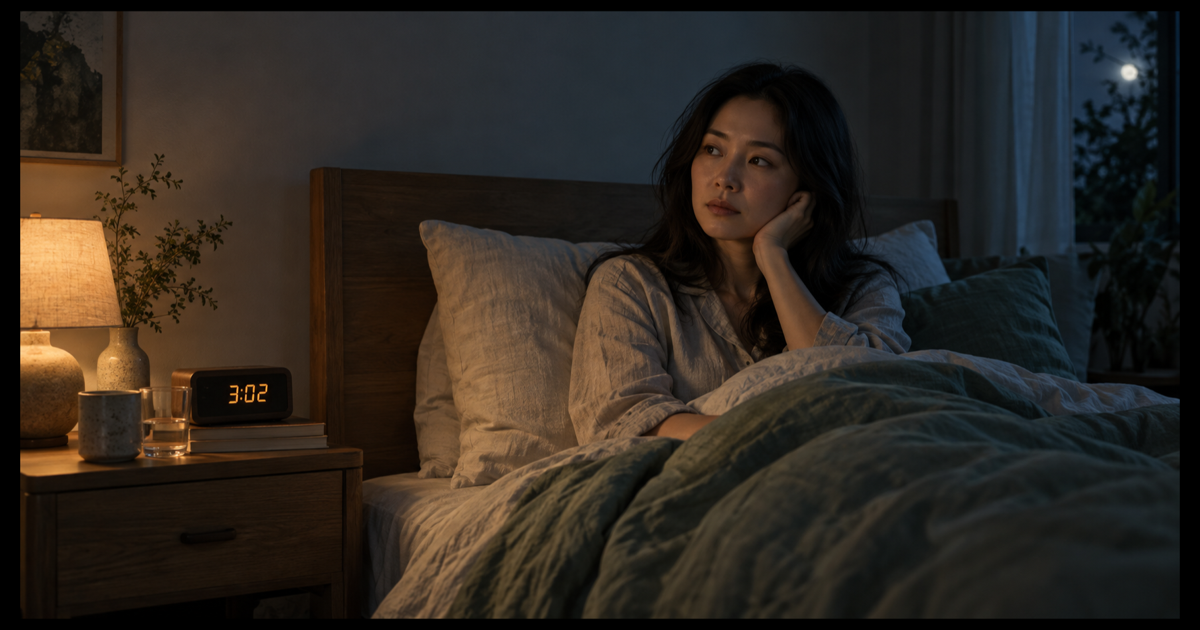
If you keep waking at 3am, the hour is worth noticing. It is not enough to tell you why.
In the traditional Chinese medicine body clock, 3am sits at the transition from the Liver window, 1–3am, to the Lung window, 3–5am. That makes it tempting to decide that one of those organ systems must be the problem. Real sleep is not that tidy. A bedside clock cannot diagnose your Liver, Lung, emotions, hormones, or nervous system.
The useful question is not, “Which organ is waking me?” It is:
What happens when I wake, what came before it, and does the same pattern repeat?
The timing can help you organise those observations. It becomes meaningful only when you read it alongside the quality of the waking, the evening that preceded it, and the effect on the following day.
First, make room for ordinary and medical causes
Waking during the night is common. Stress, anxiety, depression, noise, light, room temperature, pain, alcohol, caffeine, nicotine, medicines, menopause, shift work, jet lag, and the need to urinate can all disturb sleep. Insomnia and other sleep disorders can also show up as repeated waking or waking too early.
That list is not there to make the pattern feel meaningless. It is there to stop one appealing explanation from crowding out several testable ones.
Speak with a healthcare professional if the waking has continued for months, is becoming worse, or is making daily life difficult. Seek assessment sooner if you wake gasping or choking, snore heavily with pauses in breathing, have marked daytime sleepiness, or experience new pain, breathlessness, night sweats, significant mood changes, or another concerning symptom. Do not use an organ-clock interpretation to delay investigation.
Once those boundaries are clear, observation becomes useful rather than reassuring for its own sake.
Why does the waking feel so exact?
Human sleep follows rhythms. Across the night, the brain moves through repeated stages, and the balance of those stages changes towards morning. Circadian rhythms also influence sleep and wakefulness, hormone levels, temperature, and other body functions across roughly twenty-four hours.
The environment has rhythms too. Heating switches off. A neighbour leaves for work. Traffic begins. A partner turns over. A child wakes. The room becomes colder, warmer, lighter, or noisier. Alcohol may help someone fall asleep but make later sleep lighter and easier to interrupt.
A repeated time can therefore be real without having one fixed meaning. It may reflect the interaction between your internal rhythm, the structure of sleep, and something that happens regularly around you.
There is another complication. Once you begin worrying about 3am, checking the time can strengthen the pattern. The mind learns that waking means measuring, calculating how little sleep remains, and trying hard to force sleep. That effort can make the body more alert.
So record the time, but do not turn the bedside clock into a judge.
What Chinese medicine means by the 1–5am period
The Chinese medicine body clock divides the day into twelve two-hour windows. Each is traditionally associated with an organ system and a particular quality of activity.
The 1–3am window belongs to the Liver system. In Chinese medicine, the Liver is associated with smooth movement, planning, regulation, and the storage of Blood. The 3–5am window belongs to the Lung system, associated with breath, rhythm, boundaries, and the movement of Qi.
These are traditional functional systems, not claims that your anatomical liver stops working at 3am or that your lungs suddenly begin. Modern circadian science demonstrates that the body is rhythmic, but it does not validate the organ clock’s precise two-hour assignments.
The traditional map is most useful as a set of questions.
If you wake before 3am, do you feel tense, hot, restless, frustrated, or mentally busy? Was the evening crowded with work, alcohol, a late meal, conflict, or stimulation? If you wake after 3am, is the first thing you notice your breathing, a dry throat, congestion, sadness, a cold room, or early-morning light?
Those observations do not confirm a Liver or Lung pattern. They tell you what else belongs in the picture.
And at exactly 3am, do not force a choice. The boundary is a reminder that a living body does not change departments because a digital clock changes its number.
The five details that make timing useful
“I woke at 3am” is one fact. Add these five and it becomes a pattern you can work with.
1. What woke you first?
Notice the first sensation before the story begins. Was it heat, cold, thirst, a full bladder, pain, reflux, a sound, a dream, a racing heart, difficult breathing, or simply alertness?
The first sensation is often more informative than the thoughts that arrive ten minutes later.
2. What state was your body in?
Were you sleepy but briefly awake, or suddenly bright and unable to settle? Heavy, hungry, tense, dry, congested, sweaty, frightened, or calm?
Two people can wake at the same time while having completely different experiences. One needs help removing a disturbance. The other may be dealing with a wider sleep, health, or regulation problem.
3. What was the evening like?
Record bedtime, food, alcohol, caffeine, screens, exercise, work, emotional intensity, and room conditions. The cause of a 3am waking may begin several hours earlier.
This is also why a universal bedtime remedy is often disappointing. The same tea, supplement, breathing exercise, or routine is being asked to solve different problems.
4. Can you return to sleep?
A brief waking followed by easy sleep is different from lying awake for an hour with a racing mind. Also notice what you do next. Checking messages, turning on bright lights, eating, working, or repeatedly checking the time can change the second half of the night.
5. What happens the next day?
Do you feel restored, foggy, irritable, headachy, unusually hungry, or dangerously sleepy? Does the effect fade after breakfast or movement, or remain all day?
If you regularly wake unrefreshed, the article on different kinds of fatigue after sleeping can help you describe the next-day feeling more precisely. Persistent fatigue still deserves ordinary medical assessment.
Keep a seven-night waking note
For one week, record the pattern in daylight rather than analysing it in bed.
Write down:
- Bedtime and approximate waking time. Avoid staring at the clock repeatedly.
- The first bodily sensation. Heat, cold, pain, breath, bladder, hunger, tension, or alertness?
- The first thought or emotion. Practical worry, frustration, sadness, fear, a dream, or no clear mental content?
- The evening conditions. Food, alcohol, caffeine, activity, screens, stress, medicines, and room temperature.
- How long the waking lasted. Estimate rather than monitor every minute.
- The next-day effect. Restored, sleepy, wired, heavy, foggy, or physically depleted?
The National Heart, Lung, and Blood Institute recommends keeping a sleep diary for one to two weeks when sleep problems need assessment. Your note can help you notice patterns and can also give a healthcare professional more useful information than “I sleep badly.”
At the end of the week, look for relationships rather than a verdict. Perhaps the waking follows alcohol, a late meal, high stress, a warmer room, a particular medicine, or an irregular bedtime. Perhaps none of those explains it. That is useful information too.
Change one condition, not the whole night
If no medical warning sign is present, choose one low-risk condition to test for several nights.
You might keep the room cooler and darker, move caffeine earlier, avoid alcohol near bedtime, protect a more regular wake time, or create a quieter transition out of evening work. If you wake, keep the light low and resist solving tomorrow from bed. If you remain awake, a calm activity away from bright screens may be more helpful than struggling harder to sleep.
Do not change five things at once. A perfect evening routine can produce a better night without teaching you which part mattered. One change gives you information.
If sleep difficulty has become persistent, sleep hygiene alone may not be enough. Cognitive behavioural therapy for insomnia, usually called CBT-I, is a first-line treatment for chronic insomnia. A clinician can also assess whether pain, medication, menopause, sleep apnoea, restless legs, mood, or another condition is contributing.
What the hour can and cannot tell you
The hour can show you where to look. It can reveal that the disturbance is repeated, that it begins before bedtime, or that the waking has a consistent bodily quality.
It cannot tell you that grief is stored in your lungs, that anger has damaged your liver, or that one organ needs cleansing. It cannot tell you to take a particular herb or supplement. It cannot replace a sleep assessment.
Used gently, the traditional clock does something more modest and more useful. It stops “bad sleep” from being one undifferentiated problem. It asks you to notice timing, quality, context, and consequence.
That is the same shift at the centre of Tong Living: from reaching immediately for a general prescription to understanding the body and conditions the prescription has to meet.
For a fuller framework for reading sleep together with energy, digestion, temperature, emotion, food, movement, and climate, see Tong Living Everyday Chinese Medicine: for the Way Your Body Works.
Sources and further reading
- Insomnia: causes and risk factors, National Heart, Lung, and Blood Institute
- Insomnia: diagnosis and sleep diary, National Heart, Lung, and Blood Institute
- Sleep phases and stages, National Heart, Lung, and Blood Institute
- Circadian rhythms, National Institute of General Medical Sciences
- A patient’s guide to behavioural and psychological treatments for chronic insomnia, American Academy of Sleep Medicine
- Obstructive sleep apnoea, MedlinePlus
- Traditional Chinese Medicine: What You Need to Know, National Center for Complementary and Integrative Health