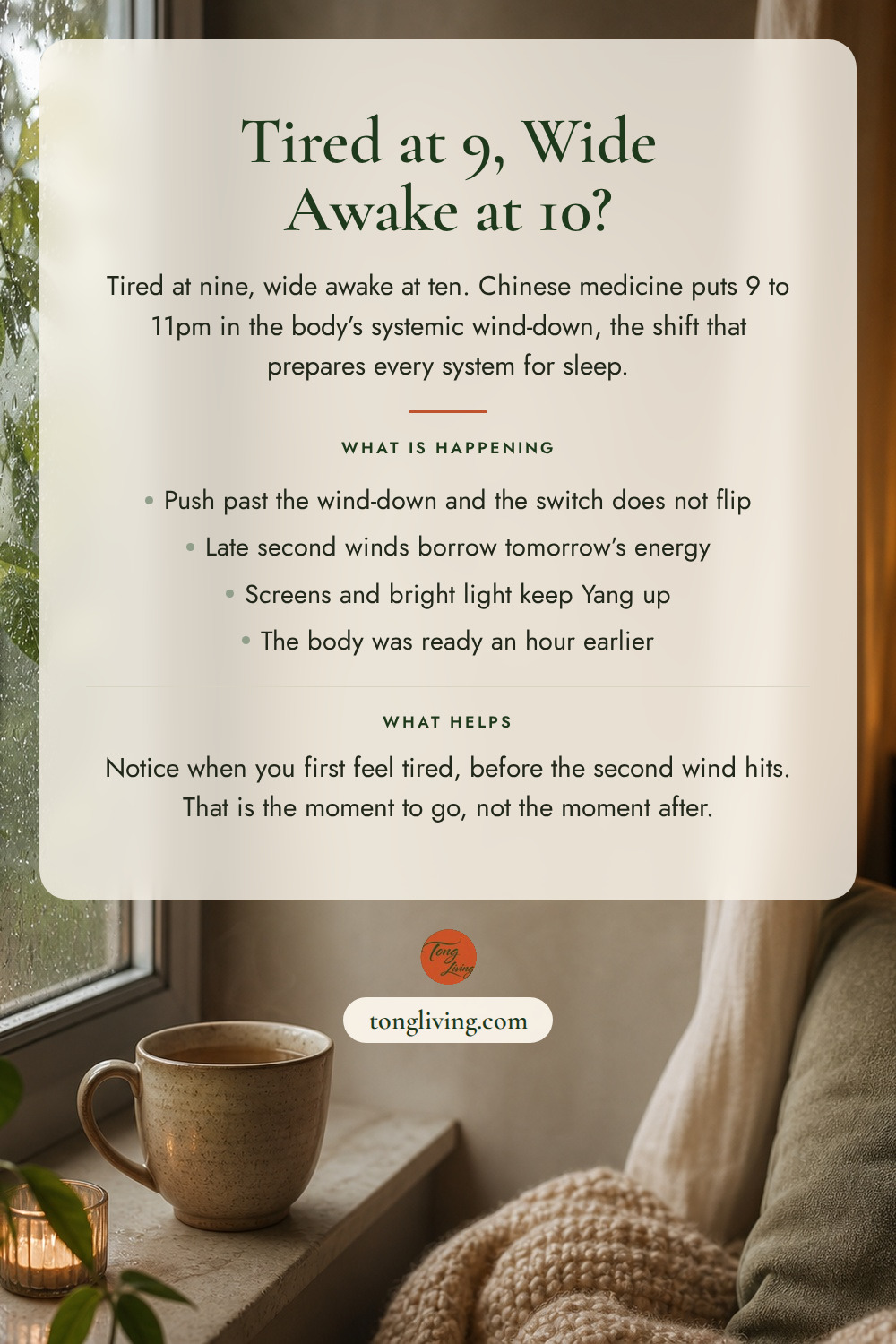

If you feel ready for bed at eight or nine, keep going, and then become unexpectedly alert later in the evening, the energy is real. It is not necessarily evidence that you have recovered or that you should stay awake.
Sleepiness is shaped by more than how tired you are. A drive for sleep builds across the day, while the circadian system also sends signals that support wakefulness and sleep at different times. For some people, those signals create a period of stronger evening alertness sometimes called the wake maintenance zone or a second wind.
Light, work, worry, caffeine, exercise, a late meal and the timing of your usual sleep can all change how that period feels. The useful question is not simply, “Why am I awake?” It is:
What happened between the first sleepy feeling and the second wind, and how do I feel the next morning?
That turns a frustrating late-night burst into a pattern you can investigate.
First, a second wind is not always a sleep disorder
An occasional evening rise in alertness can be part of ordinary circadian timing. People also differ in when their internal clocks favor sleep and wakefulness. Someone with a later schedule may become alert at a time when an earlier sleeper is already winding down.
The pattern deserves more attention when it repeatedly delays sleep, reduces the amount of sleep you get, or leaves you struggling during the day. Speak with a healthcare professional if difficulty falling or staying asleep happens at least three nights a week, lasts for months, or interferes with work, driving, mood, relationships or daily functioning.
Seek assessment sooner if you snore loudly with pauses in breathing, wake gasping or choking, have severe daytime sleepiness, fall asleep unintentionally, or experience new pain, breathlessness, marked mood changes or another worrying symptom. A “second wind” should not be used to explain away sleep apnea, a medicine effect, a mood disorder or another health problem.
Why can you feel tired and alert at the same time?
Two broad processes help regulate sleep and wakefulness.
The first is sleep pressure. The longer you stay awake, the stronger the biological need for sleep generally becomes. Adenosine is one substance involved in signaling that pressure. Caffeine can interfere with the signal, which is one reason a late coffee affects some people long after they stop feeling actively stimulated.
The second is the circadian alerting signal. Your internal clock helps organize roughly twenty-four-hour rhythms, including when you tend to feel awake and when sleep becomes easier. This signal can temporarily oppose the sleep pressure that has accumulated during the day.
Research describes a period of reduced sleep tendency in the evening, often shortly before the biological night begins. This wake maintenance zone helps explain why a person can be tired overall yet become more alert for a while. The timing is not identical for everyone, and it is not a precise clock appointment.
The two processes can therefore pull in different directions. “I am tired” and “I cannot fall asleep yet” are not mutually exclusive statements.
| Version | What tends to come before it | Useful clue |
|---|---|---|
| Natural alerting signal | A consistent evening lift, including on calm days | Clear or sociable alertness without distress |
| Renewed stimulation | Bright light, work, messages, games, or demanding activity | The alertness rises after the waking cue |
| Stress activation | Unresolved pressure, a tight jaw, shallow breath, or mental rehearsal | The body feels depleted but unable to release the day |
| Shifted schedule | Late naps, travel, shift work, irregular sleep, caffeine, or some medicines | The pattern begins after timing conditions change |
Four common versions of the evening second wind
The phrase describes an experience, not one cause. These four versions can look similar from the outside.
1. Your natural alerting signal rises in the evening
The lift arrives at a fairly consistent time, even on calm days. You may feel sociable, creative or mentally clear rather than distressed. If your schedule allows a later bedtime and you still sleep enough, the pattern may mainly reflect your timing rather than a problem to fix.
The important comparison is not with someone else’s ideal bedtime. It is with the sleep you actually obtain and the way you function the next day.
2. You were sleepy, then became stimulated again
Perhaps you nearly nodded off on the sofa, then opened a laptop, turned on bright lights, began tidying, answered messages or started preparing for tomorrow. The activity did not create new sleep. It gave the brain and body stronger waking cues.
Artificial light in the late evening can interfere with circadian signals that support sleep. Engaging work, conversation, games and emotionally charged content can add cognitive arousal even when the room itself is dim.
Notice the order. Did alertness rise by itself, or only after you began doing something that asked you to become alert?
3. You are tired but still activated by stress
Stress can produce a different kind of wakefulness. The body feels depleted, but the jaw is tight, the breathing is shallow, the mind is rehearsing a conversation, or tomorrow already feels urgent.
This is less like receiving useful energy and more like being unable to release the day. The article on why stress returns after you relax explains why a calming practice can genuinely change your state while an unresolved stressor or accumulated strain remains.
Ask what the alertness feels like. Clear and comfortably awake is different from restless, pressured, irritable or exhausted but unable to stop.
4. The whole sleep schedule has shifted
Sleeping late on days off, napping late, shift work, travel, irregular work hours and inconsistent exposure to light can move the relationship between your desired bedtime and your internal timing. Caffeine, nicotine, alcohol and some medicines can also affect sleep in different ways.
If the second wind began after a schedule change, do not assume it reveals a permanent body type. The conditions around the pattern may have changed before your identity did.
What Chinese medicine adds to the question
The Chinese medicine body clock maps the day into twelve two-hour periods. In that traditional framework, 9–11pm is associated with the San Jiao system and 11pm–1am with the Gallbladder system. These are functional ideas within Chinese medicine, not modern anatomical claims and not proof that one organ is causing insomnia.
It is also too simple to say that every late-night second wind means Yin deficiency. Chinese medicine would normally read timing together with the quality of the experience and the rest of the person’s pattern.
Someone who becomes hot, dry and restless late at night presents a different picture from someone whose mind is tense and frustrated, someone who feels heavy and full after a late meal, or someone who is calmly productive on a naturally later schedule. The hour is one clue. Temperature, digestion, emotion, stimulation, thirst, menstrual changes, energy across the day and the following morning all add context.
The traditional contribution is therefore not a single label. It is the habit of asking what kind of alertness this is, what preceded it, and what it costs afterwards.
Use the next morning as part of the evidence
A second wind can feel productive because it temporarily removes the sensation of tiredness. The following morning shows whether it restored you.
Notice whether you wake:
- clear and adequately rested;
- heavy and difficult to start;
- foggy but better after food or movement;
- tense and already alert;
- headachy, thirsty or congested;
- or sleepy enough that driving and concentration feel unsafe.
If you regularly sleep for what seems like enough time but still wake depleted, different kinds of tiredness after sleeping can help you describe the after-effect more precisely. Persistent or severe fatigue still needs ordinary medical assessment.
If the second wind is followed by waking at the same time later in the night, the article on repeated 3am waking explains how to investigate the timing without assigning it automatically to one organ system.
Try a five-evening timing experiment
If the pattern is mild and no warning sign is present, observe it for five ordinary evenings before rebuilding your whole routine.
Record the first real sleepy signal
Write down the first time you notice unmistakable sleepiness: heavy eyelids, yawning, losing your place while reading, becoming quieter, or wanting to lie down. Do not wait until bedtime to reconstruct it.
Record what happened next
Note the light level and what you did during the following hour. Did you start work, scroll, watch something stimulating, eat, exercise, argue, plan, or simply continue a calm activity? Include caffeine, alcohol, nicotine, medicines and naps.
Describe the second wind rather than merely naming it
Was it clear, cheerful and focused? Hot and restless? Anxious? Hungry? Physically tired but mentally fast? Did it arrive before an activity or after it?
Record sleep and the next day
Estimate when you tried to sleep, how long settling took, when you woke and how you felt the next morning. Avoid repeatedly checking the clock in bed. The aim is to collect useful information, not to turn sleep into a nightly examination.
After five evenings, look for a relationship. You may find that the second wind follows bright light, late work, a nap, caffeine, worry or pushing past the first sleepy period. You may find that it arrives at the same time regardless. Either result gives you a better starting point than “my body is broken at night.”
Change one condition at a time
Choose one low-risk experiment that matches what you observed.
If the alertness follows light or work, dim the environment and close demanding tasks before the first sleepy signal usually appears. If your sleep schedule varies widely, protect a steadier waking time for several days. If caffeine may be involved, move it earlier rather than adding more rules at bedtime. If worry accelerates at night, give tomorrow’s practical tasks a written place before the evening ends.
Keep daytime light exposure and ordinary movement in the picture too. A body clock is shaped across the whole day, not only in the final fifteen minutes before bed.
Do not change light, food, exercise, supplements, bedtime and caffeine all at once. A perfect night might feel encouraging, but it would teach you little about which condition mattered.
If sleep difficulty has become persistent, sleep hygiene may not be enough. Cognitive behavioral therapy for insomnia, or CBT-I, is a recommended treatment for chronic insomnia. It addresses sleep timing, behavior and the learned association between bed and wakefulness. More intensive techniques such as sleep restriction are best undertaken with appropriate clinical guidance rather than improvised from a short article.
The second wind is information, not a command
Late-evening alertness does not automatically mean you should stay up, and early-evening sleepiness does not automatically mean you must go to bed immediately. The pattern becomes useful when you connect it to what happened beforehand, the quality of the alertness, the sleep that followed and the condition of the next day.
Sometimes the answer is ordinary: the lights went on, the work became interesting, or coffee lasted longer than expected. Sometimes stress is keeping a tired body mobilized. Sometimes your preferred schedule and your obligations do not match. Sometimes the timing belongs to a wider sleep problem that deserves professional care.
Chinese medicine adds a disciplined curiosity about timing and bodily qualities. Modern sleep science adds tested explanations for sleep pressure, circadian alertness and environmental cues. Neither requires you to turn one late burst of energy into a diagnosis.
For the fuller Tong Living method for reading timing together with sleep, digestion, temperature, emotion, food and movement, see Tong Living Everyday Chinese Medicine: for the Way Your Body Works.
Sources and further reading
- How Sleep Works: Your Sleep/Wake Cycle, National Heart, Lung, and Blood Institute
- Insomnia: Treatment, National Heart, Lung, and Blood Institute
- Insomnia: Diagnosis, National Heart, Lung, and Blood Institute
- Improved Neurobehavioral Performance during the Wake Maintenance Zone, Journal of Clinical Sleep Medicine
- Behavioral and psychological treatments for chronic insomnia disorder in adults: an American Academy of Sleep Medicine clinical practice guideline
- Traditional Chinese Medicine: What You Need to Know, National Center for Complementary and Integrative Health