You notice that something is off, but knowing the symptom does not tell you what to do next. You are tired, bloated, tense, cold, restless, or foggy. The usual advice gives you a list. Your body needs a direction.
The short answer
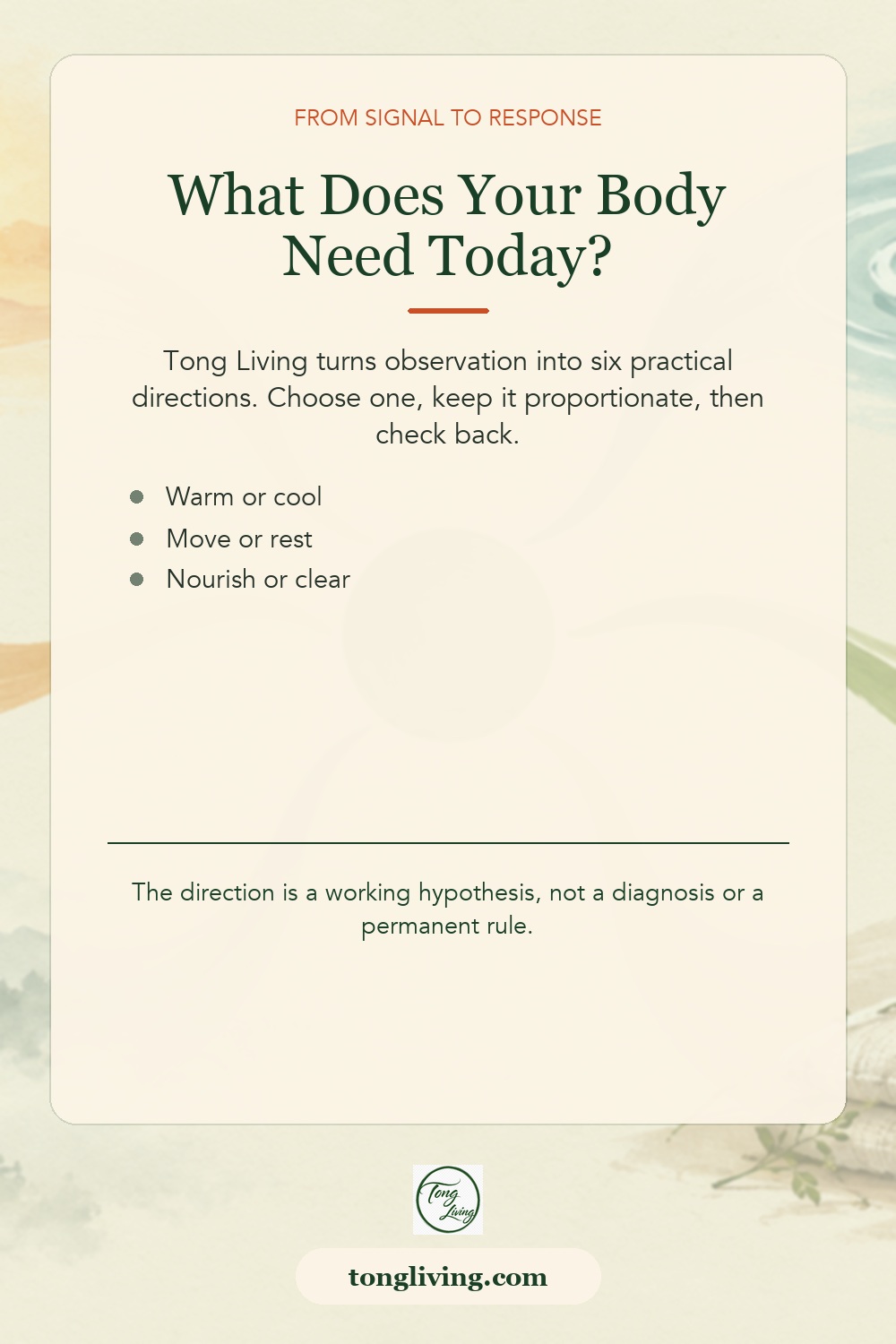
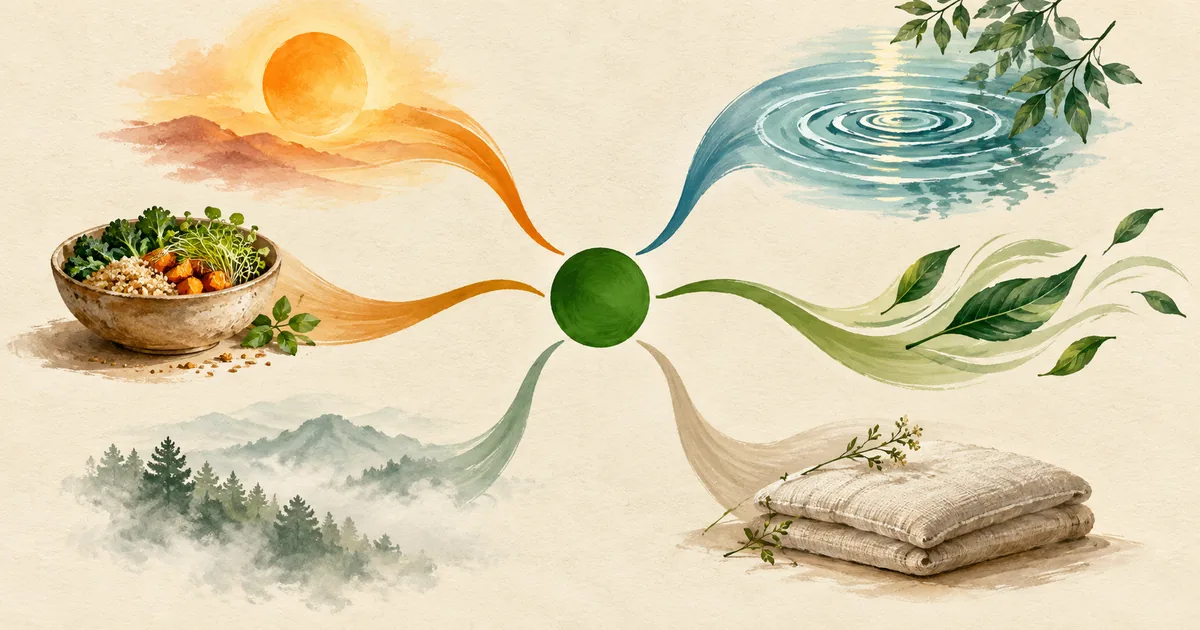
Tong Living uses six directions of support: warm, cool, move, nourish, clear, and rest. They are not six treatments or six permanent body types. They are a way to translate what you notice into one proportionate response, then check whether the response helped.
The loop is simple: notice, read the direction, respond, and check back. If the result is wrong, you have learned something. You adjust rather than forcing the plan.
Why start with a direction instead of a remedy?
A remedy is specific. A direction explains why it might fit.
Ginger tea, an early night, a walk, and a bowl of soup are not interchangeable tips. Ginger and soup may bring warmth. A walk may move something constrained. An early night may protect capacity that has been overused.
When you know the direction, you can choose among many ordinary responses that fit your life. When you only know the remedy, you can repeat it long after the reason has changed.
This is also why the same advice does not work for everyone. Two people may share a symptom while leaning in opposite directions. The article on why sensible health advice can fail explains that problem in more detail.
When might your body need warmth?
Consider warmth when you feel cold, sluggish, slow to start, or worse after chilled food and cold weather. Warmth might come from cooked food, layers, gentle heat, movement that does not exhaust you, or an earlier night that protects your reserves.
Warmth is not the right direction for every tired person. If you are flushed, thirsty, restless, or uncomfortable after spicy food and alcohol, adding more heat may intensify the problem.
If cold hands and feet are your clearest signal, read why poor peripheral warmth can have several different explanations.
When might your body need cooling?
Cooling may fit when you feel overheated, flushed, dry, irritable, or unable to settle because the system feels too activated. The response may be shade, less spice and alcohol, lighter food, a comfortably cool room, fewer inputs, or a quieter breath.
Cooling does not mean icing the body or restricting food. It means reducing unnecessary heat and stimulation while preserving adequate nourishment.
When might your body need movement?
Movement fits when capacity seems present but constrained: tension that wants release, bloating that changes with stress, restlessness after sitting, a held breath, or emotion that has nowhere to go.
Movement can be a walk, stretch, song, conversation, long unforced exhale, or the act of beginning a task that has become mentally jammed. More intensity is not automatically more movement. If exercise leaves you paying for it the next day, the dose was larger than the body could absorb.
Use the rest-or-move test when you cannot tell whether activity will give something back or take more away.
When might your body need nourishment?
Nourishment fits when you feel empty, depleted, weak, hollow, or unable to recover. The direction may include adequate food, warmth, sleep, emotional support, and reducing output long enough for something to rebuild.
Nourishment is not indulgence, and it is not always more food. It means supplying what is missing rather than demanding another performance from an under-resourced system.
When might your body need clearing?
Clearing may fit when you feel heavy, foggy, puffy, congested, or burdened by too much. The response may be simpler food, fresh air, gentle movement, finishing one accumulated task, reducing alcohol, or removing an input that repeatedly leaves you worse.
Clearing is not detoxification in the commercial sense. Your liver, kidneys, lungs, gut, and skin already perform essential physiological work. This direction is about reducing an ordinary burden and restoring movement, not buying a cleanse or purging the body.
When might your body need rest?
Rest fits when you are wired, frayed, overextended, or unable to settle after too much input. It may mean sleep, stillness, fewer decisions, protected downtime, or ending the day before a second wind carries you past your limits.
Rest is not always lying down. For someone whose mind is crowded but whose body has been still all day, a quiet walk may be the form of rest that actually changes the state.
Can you need two directions at once?
Often. A cold, heavy morning may ask for warmth and clearing. A wired, overheated evening may ask for cooling and rest. Depletion with tension may need nourishment before movement becomes useful.
This is why the six directions are not a quiz with one final result. They are coordinates. They help you choose a first move without pretending the body is simple.
The six practical Tong Living body patterns each lean toward one or two directions, but patterns and directions can change as your circumstances change.
How do you use the Tong Living loop?
1. Notice
Name what is actually present. Cold or hot? Empty or heavy? Tense or weak? Better with movement or worse after it? Do not begin with what you think you should feel.
2. Read the direction
Choose the smallest direction that makes sense: warm, cool, move, nourish, clear, or rest. If two fit, decide which one needs to come first.
3. Respond
Choose one safe, ordinary action. Make it small enough that you can still tell what it did.
4. Check back
Did you become clearer, steadier, warmer, more comfortable, or better able to continue? Did nothing change? Did you feel worse? The answer determines the next loop.
What are the limits of this framework?
The six directions are a self-observation tool, not a diagnosis or treatment plan. They do not explain severe, sudden, persistent, or worsening symptoms. Do not use them to delay medical care or replace treatment you already need.
If the picture is complex, conflicting, or not improving, a qualified healthcare professional can assess medical causes. If the question is how several ordinary signals fit together, a one-to-one body pattern session can offer educational, complementary guidance without replacing medical care.
What makes a response “Tong”?
Tong means easy, unobstructed flow. The aim is not perfect control. It is to notice where the system is leaning, make one fitting adjustment, and listen to what comes back.
Warm, cool, move, nourish, clear, rest. These are not rules to master. They are six ways home.
The full method, including timing, rest, movement, food, emotion, and climate, is developed in Tong Living Everyday Chinese Medicine: for the Way Your Body Works.
Sources and further reading
- Traditional Chinese Medicine: What You Need To Know, National Center for Complementary and Integrative Health
- Evaluating Health Information, MedlinePlus