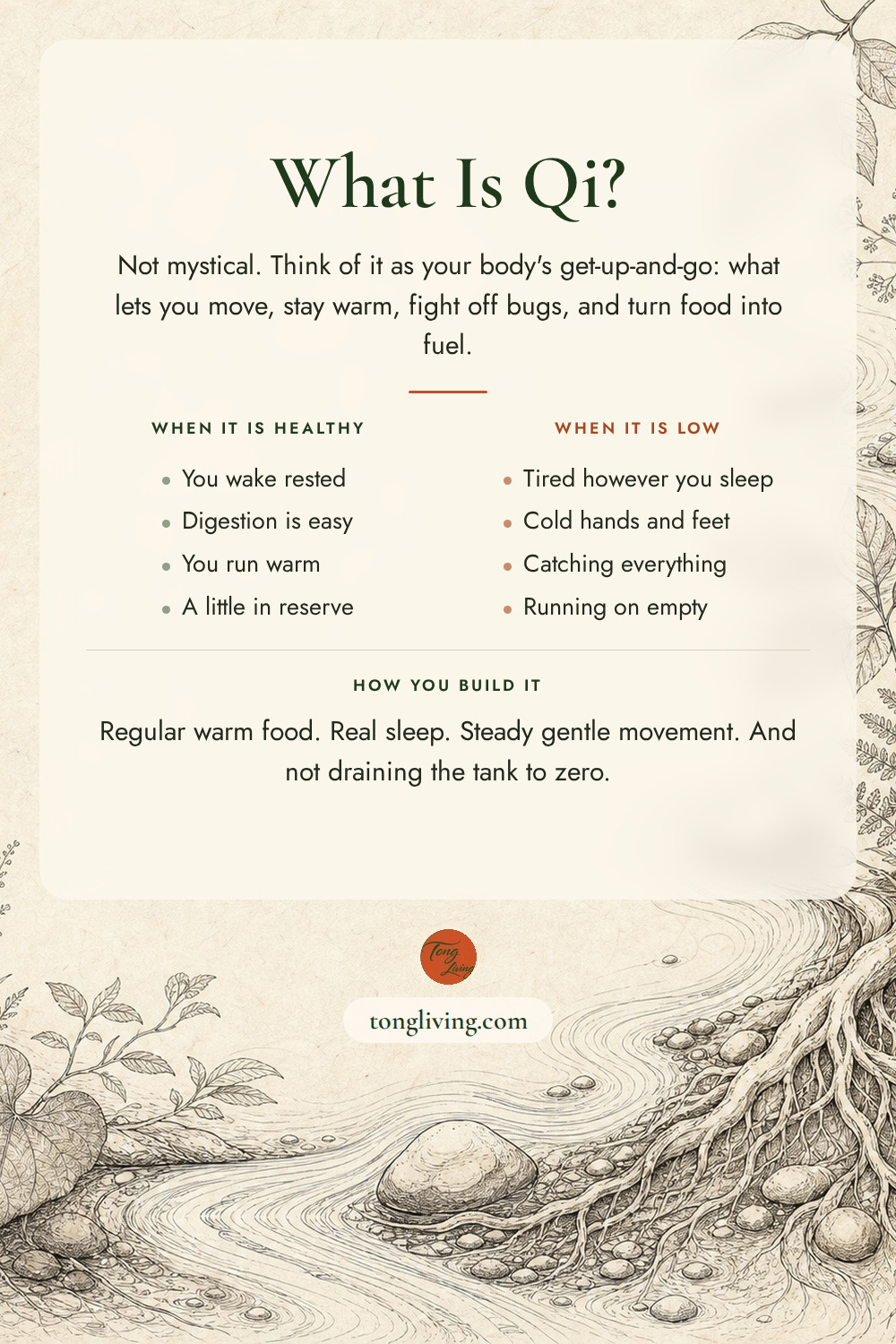

Qi is not a substance that can be isolated in a blood test, and it is not another name for calories, oxygen, electricity or metabolism. It belongs to the traditional language of Chinese medicine rather than to modern anatomy.
The most useful plain-language explanation is this: Qi describes functional capacity and activity. It is a way of talking about whether the body can warm, move, transform, protect and recover, and whether those functions are happening freely and in the right direction.
That is why two people can both say, “I have no energy,” while Chinese medicine asks two different questions. Does the person lack capacity, or is capacity present but unable to move well? One may need rest and nourishment. The other may feel better after movement, expression or a change of pace.
Qi is not a medical diagnosis. It is a traditional framework for organizing observations. Used carefully, it can help turn a vague complaint into a more precise question.
Why “energy” is useful but incomplete
“Energy” is the usual English shorthand for Qi because it captures part of the experience. When Qi is described as abundant, a person may feel capable, alert and resilient. When it is described as deficient, ordinary tasks may feel disproportionately demanding.
But energy can sound like a quantity stored in a battery. Qi is broader than that. Chinese medicine also pays attention to movement, direction, timing and relationship.
For example:
- digestion is expected to receive food and move what is useful onward;
- breathing involves a regular exchange in and out;
- circulation and warmth need to reach the body rather than collect in one place;
- activity should be followed by an appropriate ability to settle and recover;
- emotion should be able to arise, move and change rather than remain fixed as tension.
In this language, a problem is not always “too little.” Something may be present but constrained, rising when it should descend, lingering when it should move on, or appearing at the wrong time of day.
This is why translating Qi as “life force” can create more confusion than clarity. It encourages people to imagine an invisible material. The traditional concept is better approached as a vocabulary for function and change.
Three questions make Qi practical
When Chinese medicine uses the word Qi, three questions usually make the idea easier to understand.
1. Is there enough capacity?
Can the body meet an ordinary demand and recover from it? Or does a normal meal, walk, conversation or working day feel as though it uses everything available?
In traditional terms, persistent tiredness, a weak voice, easy breathlessness, frequent illness or slow recovery may contribute to a picture described as Qi deficiency. This does not identify a biomedical cause. Fatigue can arise from sleep disorders, anemia, thyroid conditions, infection, medication, depression and many other factors that require ordinary medical assessment.
The traditional question is narrower: does the overall picture look as though the system lacks the capacity to perform and restore its usual functions?
2. Is activity moving freely?
A person can have drive and still feel blocked. The day may begin with capability, but pressure gathers in the jaw, shoulders or chest. Frustration rises quickly. There may be frequent sighing, stress-linked digestive changes, a sense of being unable to settle, or relief after walking, stretching, talking or crying.
Chinese medicine may describe that kind of picture as Qi stagnation. Again, this is not a biomedical diagnosis and does not prove that one mechanism is responsible. It is a way of noticing that the problem may be constrained movement rather than an absolute lack of resources.
This distinction helps explain why the same advice can affect two tired people differently. A demanding workout may make a depleted person feel worse, while suitable movement may help someone whose tension eases when they move. The article on whether to rest or move develops that comparison in practical terms.
3. Is the activity moving in the right direction and at the right time?
Chinese medicine often describes bodily functions through direction. Food and fluids should be received, transformed and moved onward. Breathing should have an easy rhythm. After activity, the body should be able to settle. At night, alertness should give way to sleep.
This is descriptive language, not a literal map of forces traveling through the body. Its value lies in the questions it creates. Is nausea a feeling of upward movement? Does worry make the stomach tighten? Does alertness arrive just when the person wants to sleep? Does the same symptom appear at a repeatable time?
The answer does not establish a diagnosis, but it can reveal a relationship worth investigating.
Low Qi and stuck Qi do not feel the same
The contrast between deficiency and stagnation is one of the most practical ways to understand Qi.
When capacity seems low
You may notice that:
- the tiredness is present before you begin;
- small demands feel unusually expensive;
- exertion leaves you depleted rather than pleasantly used;
- rest helps, but recovery is slow or incomplete;
- the wider picture includes poor sleep, reduced appetite, breathlessness or frequent illness.
If this is persistent, worsening or out of proportion to your circumstances, it deserves healthcare assessment. The traditional label does not tell you why your capacity is low.
When movement seems constrained
You may notice that:
- capability is present, but tension builds as the day continues;
- symptoms become more noticeable under pressure;
- the jaw, neck, chest or abdomen feels held;
- you sigh, pace or feel an urge to move;
- suitable movement or expression brings at least temporary relief.
This is why yoga, music or a walk can produce real relief without resolving the source of ongoing stress. The activity may help what has accumulated to move, while the demands, habits or unspoken conflicts that create the tension remain. Why stress returns after you relax explores that difference.
Many people show elements of both. Long periods of strain can leave a person tense and tired at once. Categories in Chinese medicine are not personality types, and they should not be used to force every experience into one box.
Qi is understood through patterns, not one symptom
No single feeling proves that Qi is deficient or stagnant. Tiredness, bloating, cold hands, tension and poor sleep can each have many explanations.
Chinese medicine asks what appears together:
- When did it begin?
- What was happening around it?
- What makes it better or worse?
- Is the person warm or cold?
- How are appetite, digestion, sleep and mood changing with it?
- Is the problem constant, or does it follow a time, meal, season or demand?
The cluster matters more than the isolated symptom. That is the principle behind reading a body pattern in Chinese medicine. A pattern is a working interpretation of relationships, not a substitute for a medical diagnosis.
This also explains why apparently sensible health advice does not work equally for everyone. Advice acts on a particular body in a particular state. The article on why health advice does not work the same for everyone explains that starting point.
What Qi does not mean
Qi is sometimes presented online as though it were a scientifically established fluid, electrical charge or field. That goes beyond the evidence. There is no accepted biomedical measurement that identifies Qi as a discrete physical entity, and traditional meridian language should not be mistaken for modern anatomical structures.
That does not make the term useless. Many systems of thought use organizing concepts that are valuable within their own framework. The responsible approach is to keep the boundaries visible:
- Qi is a traditional concept, not a laboratory finding.
- A Qi pattern is not another name for a disease.
- Feeling better after a practice does not prove a proposed mechanism.
- Observation can guide a better question, but it cannot rule out illness.
- Chinese medicine should complement appropriate healthcare, not delay it.
Seek medical advice for new, persistent, severe or worsening symptoms, especially unexplained fatigue, fainting, chest pain, breathlessness, neurological changes, significant weight change or symptoms that interfere with daily life.
A simple way to observe function without diagnosing yourself
For one week, choose one ordinary activity that often changes how you feel. It might be lunch, a walk, a difficult meeting or the transition from work to evening.
Record four things:
- Capacity before it: Did you begin steady, tired, wired or already depleted?
- Response during it: Did the body open and engage, or did tension and effort accumulate?
- Recovery afterwards: Were you restored, calmer, restless or exhausted?
- Context: What had you eaten, how had you slept, what time was it and what emotional pressure was present?
Do not use the notes to award yourself a pattern label. Use them to compare days. If gentle movement repeatedly releases pressure, that is useful information. If even modest activity repeatedly causes disproportionate exhaustion, that is different information. If the change appears mainly after meals or at one time of day, timing belongs in the description.
The goal is not to decide whether your Qi is “good” or “bad.” It is to notice how capacity, movement and recovery relate in your actual life.
The practical meaning of Qi
Qi gives Chinese medicine a language for asking how the body is functioning, not merely where a symptom is located. Is there enough capacity? Is activity moving freely? Is it moving in an appropriate direction and rhythm? What else changes with it?
Those questions do not replace medical testing. They do make “I have no energy” more precise. One person may need rest, nourishment and investigation of persistent fatigue. Another may need movement, expression and fewer sources of repeated tension. A third may need both, but at different moments.
That is the practical value of Qi: not a mystical answer, but a disciplined way to observe function and change.
For the fuller Tong Living method for reading Qi together with digestion, sleep, temperature, emotion, movement and climate, see Tong Living Everyday Chinese Medicine: for the Way Your Body Works.
Sources and further reading
- WHO International Standard Terminologies on Traditional Chinese Medicine, World Health Organization
- Traditional Chinese Medicine: What You Need to Know, National Center for Complementary and Integrative Health
- The Idealist and Pragmatist View of Qi in Tai Chi and Qigong, Journal of Integrative Medicine